

Harry Ward Beecher (1813 – 1887) said, “Difficulties are God’s errands and when we are sent upon them, we should esteem it as proof of God’s confidence…as a compliment from Him.”
My mother always told me that our trials made us better people. She insinuated that I was growing from each experience I had. She would tell me that God must really love me to give me trials to bear. I remember telling her, “Mom, I wish He didn’t love me so much.” She would laugh and then hold me in her arms as she comforted me.
Monte J. Brough said, “Many of the most important principles of intelligence cannot be taught at universities, from books, or through other temporal learning processes. Often these great principles are learned from afflictions, tribulations, and other mortal experiences.” (Monte J. Brough, “Lessons from the Old Testament: Adversity, the Great Teacher”, Ensign, Aug. 2006, 9–11)
Difficulties make us stronger people. Life was not easy for those who were prominent in history. Helen Keller was a deaf-blind American suffragist, activist, author, and lecturer. She graduated from Radcliffe College magna cum laude, the first deaf-blind person to graduate. She eventually became a world-famous speaker. She had everything against her from birth, but she fought to come out of her quiet and lonely world. She succeeded.
Martin Luther King was a Baptist Minister and a leader of the American Civil Rights Union. He was a peacemaker, campaigning for racial equality and did not condone violence. He had to struggle for equality, for human rights that were held back unlawfully. Because of his efforts, King received the Nobel Peace Prize. After his assassination, he was awarded the Presidential Medal of Freedom.
Thomas Edison was sixty-seven years old when he had one of the greatest trials of his life, but he didn’t let it get him down. He was an optimistic man. One evening his film plant caught fire. Spontaneous combustion had ignited some of the chemicals and exploded. Within seconds, all of the celluloid for records, film, packing compounds, and anything flammable went up in flames. Fire trucks from eight towns arrived as fast as they could, but the intense heat was so powerful that the water from the fire hose had no effect whatsoever.
When Edison’s daughter arrived, she was frantic with worry. As she saw her father running toward her, she was ready to comfort him, knowing that he must be upset. Before she could say a word, he called out to her, “Where’s your mother?” Her eyes widened at such a question as he added, “Go get her and tell her to bring her friends. They’ll never see another fire like this as long as they live.”
The following morning, when the building was only rubble and ashes, he called his employees together and announced with confidence, “We’re building again. By the way, does anybody know where we can get some money?”
Practically everything we recognize as an Edison invention came after that devastating disaster. Many times difficulties make us stronger people. If we don’t let it get us down, we will end up successful.
Marion G. Romney (1897 – 1988) said, “If we bear our afflictions with understanding, faith and courage…we shall be strengthened and comforted in many ways.”
When a blacksmith takes a piece of raw iron ore and plunges it into hot coals, he burns off impurities and infuses carbon to make it stronger. He then hammers it on an anvil to forge and shape and strengthen it into something useable, something of value. This process is repeated over and over again. This can be compared to the trials we go through. We’re like this piece of ore. We’re gradually being strengthened and will eventually end up victorious.
There is an old saying, “Storms make oaks take deeper roots.” If the oak never had to fight for sun and water, but had everything given to it, it wouldn’t amount to much. In other words, the stronger the storm, the stronger the tree. These trials help us mature and grow.
The greater the storm, the more we tend to struggle and seek protection from the wind and rain. It’s only natural. But we must rise above our problems, become humble, and continue on. That’s where the line is drawn between those who give up and decide that it’s not really worth it and those who have faith in themselves and in a loving God.
Storms cause us to struggle, to fight for our survival, but we have to look beyond our troubles and stumbling blocks. Every time we fall, we must get back on our feet and start again. Life was not meant to be easy. If it were, then we would never grow and become a better person.
Spencer W. Kimball said: “The Lord has all power to control our lives, save us pain, prevent all accidents, drive all planes and cars, feed us, protect us, save us from labor, effort, sickness, even from death, if He will. But He will not. We should be able to understand this, because we can realize how unwise it would be for us to shield our children from all effort, from disappointments, temptations, sorrows, and suffering. Suffering can make saints of people as they learn patience, long-suffering, and self-mastery.” (Spencer W. Kimball, Faith Precedes the Miracle. 1972.)
We must realize that when we are faced with trials, the Lord is there to help us through them. He does not want us to face our trials alone. George MacDonald (1824 – 1905) said, “How often we look upon God as our last and feeblest resource! We go to Him because we have nowhere else to go. And then we learn that the storms of life have driven us, not upon the rocks but into the desired haven.”
The Lord loves us a great deal and wants to mold us into better people. There is a story about a currant bush that helps us to understand this principle more clearly.
A gardener was pruning his shrubs and among them was a currant bush. He worried that it would not produce much fruit so he decided to prune it and cut it back. When he finished trimming it, there wasn’t much left of the little currant bush. He examined it thoroughly and noticed that each small stump had a drip of sap on it where he had pruned it, as if it were a tear.
The gardener considered what he had done and thought he heard the little bush say: “Did you say you were my friend? How could you do this to me? You planted me and took care of me. You made sure I had plenty of water and nurtured me so I would grow. Didn’t you notice that I was growing tall and bushy from all your care? I could have been as tall as those trees across the way. Now look at me! My branches are cut away. My beautiful green leaves are no more. No one will take notice of me now.”
The gardener looked at the forlorn currant bush with understanding and said, “Please don’t cry, little one. What I did was necessary so you would be a prize currant bush and give us much fruit. You were not supposed to be like the trees, giving shade to others. You need to understand that if I had not cut you back, you would have gone to wood and given me very little fruit…if any. This is your soul purpose in life. So please don’t cry, little one. This is for your own good. One day you will understand why I had to do this. Before long, you will have delicious fruit loaded on every branch. Then you will realize that what I have done was for the best and you will thank me. You will then know that I was wise as I lovingly cut away the woody growth. You will understand that I was your friend, that I loved you and cared for you.” (Hugh B. Brown, Eternal Quest, Salt Lake City: Bookcraft, 1956, pp. 243-245)
We can compare this story to our life. The gardener is the Lord and we are the currant bushes. He is pruning us so we can be a better person. Sometimes we feel that our trials are unbearable and we don’t realize that the Lord understands how we feel and that He is here to help us through it. But, we must have faith in His pruning.
I have a question for you to ponder. If we haven’t experienced trials in our lives and haven’t shed any tears, is it possible to fully understand another person’s grief? How can we comfort another person if we don’t experience a few sorrows in our life? Many times our sorrows and problems help us to understand another person’s sorrow. When we go through similar trials, then we are more sympathetic toward others. We can tell them that we truly understand and this helps a great deal. We can cry with them as the Savior cried with Mary and Martha when He saw their sorrow because they had lost their beloved brother, Lazarus.
Spencer W. Kimball once said, “Is there not wisdom in God giving us trials that we might rise above them, responsibilities that we might achieve, work to harden our muscles, sorrow to try our souls? Are we not exposed to temptations to test our strength, sickness that we might learn patience?” (“Tragedy or Destiny?”, Spencer W. Kimball, 2006, p. 11–21)
At thirteen years of age, the doctors found out that I had scoliosis of the spine. I was then operated on, fusing eleven vertebrae, from my neck to my hips, and then put into a body cast. I would not be able to have a normal life for the next three years. I wouldn’t be able to climb another tree, ride a bike, or do any active sports. I was a tomboy so this was hard on me.
In the summer, when it was hot, I would sprinkle baby powder under my cast so I would smell sweet, plus it helped the many itches go away which a cast seems to provide. Many months passed and I was finally put into a rigid brace, which I had to wear at all times. There was only one good thing about this brace. I was able to take a “real” bath and not just a sponge bath.
With great joy, we went back to the Hospital to take off my brace forever. I felt this was the happiest day of my life. Little did I know this day of joy would not last long! As the doctors checked me, they found that I had a crack in my spine. Dr. Hess told me this was unusual and that I had to have another operation. My heart sank. I wanted to cry in front of the doctors, assistants, and my parents. I could not believe this was happening to me. Why couldn’t I live a normal life of a teen-ager? Why did I have to go through these trials?
“Why?” I asked my Father in Heaven. “Why do I have to go through this again? Why me?”
My parents and I went home and agreed to pray every day for the next four months to help me gain enough strength, mentally and emotionally, to have this operation. But each time I prayed, I asked God for a miracle. I did not want to have another operation and more casts. I begged, “Please, Heavenly Father! I want to be a normal teen-ager. Please let me have a miracle.” But it was not meant to be. I had to have the operation.
As time passed, my strength and faith grew until I had enough strength emotionally to have the operation. I realized this was a trial I had to bear. I grew spiritually at this time because I needed to lean on the Lord. I could not do this alone. I needed to know what faith was and how it worked. I needed to talk with God.
It was a beautiful summer day, when we arrived at the doctor’s office to have my last brace removed. I was sixteen years of age, almost seventeen, when my ordeal came to an end. I had become very close to my Father in Heaven during this time of trial. Three whole years!
I grew from this experience. I changed for the better. I look back at this conflict and I wouldn’t change a thing. I’m a different person. I overcame my weaknesses and turned to God as a young teenager.
We grow from the many experiences we have in life. The hard-knocks teach us patience. It helps to mold us into better people. We can compare it to a rough stone that tumbles in a streambed and gradually becomes smooth and beautiful. All the jagged edges have been worn off. The result is a beautiful polished stone or agate.
Disappointments are part of life and we grow as we learn to endure them. Sometimes we have physical or mental stress put upon us at the most inconvenient time of our lives. We just want life to go smoothly, as it was before, with no conflict. If we could find a way out, then we would take it.
“Adversities are temporary. What is permanent is what we become by the way we react to them.” ~ Dallin H. Oaks
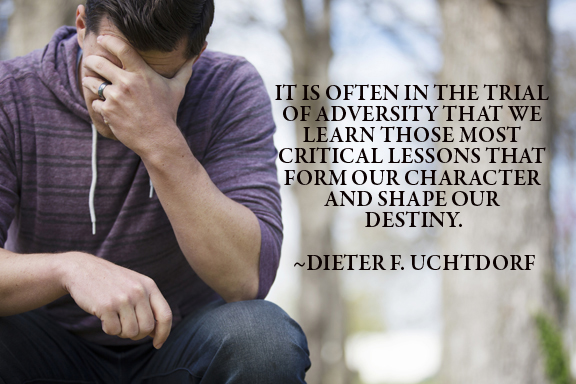
I love what Dieter F. Uchtdorf said about our trials in life. He said, “It is often in the trial of adversity that we learn those most critical lessons that form our character and shape our destiny.”

Reflections of the Heart has inspirational advice for all ages. You will learn the secret of happiness and how to deal with the trials in your life. Does music really soothe the soul and help you when you’re frustrated? Does it matter what kind of music you listen to? Is laughter really the best medicine? If so, how does it make a difference in your life? How important is it to develop your spirituality? Equal partners in marriage is a subject that can help a marriage grow stronger. These are the subjects discussed in this book.


