Ancient America, Writing and Arts

The Mystery Behind Superstition Mountain

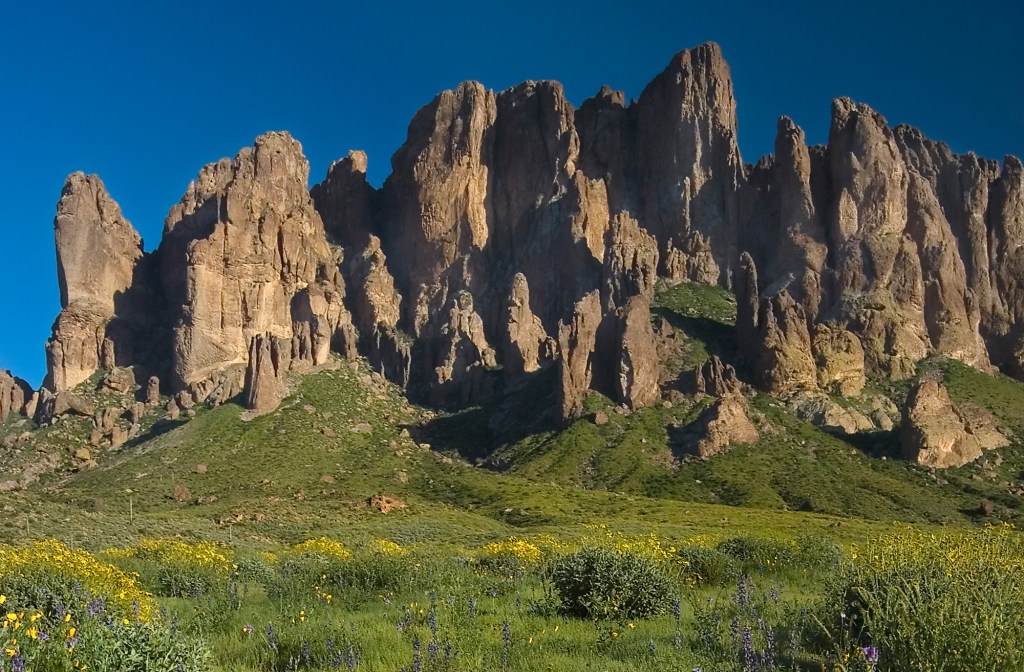
Superstition Mountain

Superstition Mountain is believed to have great treasure hidden within. Many people have tried to find it but have never succeeded. It is difficult to explore because of its dangerous cliffs and plateaus. It’s a treacherous mountain and many adventurers never come back.

It is located east of Phoenix and is famous for the Lost Dutchman’s Mine where millions of dollars worth of gold are hidden. The history of this mountain would astound you. Those who discovered the mine were in grave danger, especially if they took any gold from this spot. This was considered sacred ground. People disappeared and mysterious deaths occurred. That was why it was called Superstition Mountain.

Those who discovered its whereabouts usually met with an accident. The men who escaped unharmed would plan to return but something always happened to them. They would get sick and die or get in a fight and get killed. Now you know how this mountain got its name.

In 1540, a conquistador by the name of Francisco Vasquez de Coronado went to southern Arizona, searching for the Seven Golden Cities of Cibola. When he talked to the Apaches, they admitted the mountain held an abundance of gold but refused to help because the land was sacred and they feared the great Thunder God. As the Spaniards explored the mountain, men began to vanish. The Apaches told them the great Thunder God had destroyed them. At first they didn’t believe it until they found the bodies of a few men who had mysteriously died. This frightened Coronado’s men and they refused to continue searching. When Coronado realized his men were right, he named it Superstition Mountain.

In 1845, Don Miguel Peralta went searching for the gold and discovered a large amount hidden in the mountain. He couldn’t believe his luck and named it Sombrero Mine. The area looked just like a sombrero. It had a point like a hat with a wide brim. But others thought the peak of the mountain looked more like an index finger pointing toward the sky, so they named it the Finger of God. But that’s not the name it goes by today. When an explorer named Paul Weaver scratched his name in the rock below the tall spire, its new name became Weaver’s Needle.

Peralta soon discovered the richest gold mine in all western history and began shipping it back home to Mexico. When the Apache noticed what was happening, they became angry because they had trespassed onto sacred ground and were stealing what was theirs. In 1848, they decided to drive the foreigners off their land. When Peralta found out, he quickly concealed the mine and headed home with his mules and wagons packed to the brim with gold. But it was too late. A battle pursued and the Apache warriors killed the Spaniards.

In 1870 Jacob Waltz became good friends with a Dutchman named Jacob Weiser and they went in search of this lost gold mine together. One day they showed up in Phoenix, buying whiskey for everyone, celebrating their great fortune with golden nuggets. No one knew where they’d gotten it. They wouldn’t reveal its whereabouts but many suspected they had found the Sombrero Mine. Some say that they stumbled upon it and others say a descendent of Don Miguel Peralta had a map and sold it to them. For the next ten years, they continued bringing in gold nuggets. When Jacob Weiser disappeared, Waltz became paranoid and took extra care to not allow anyone to follow him to the mine. What happened to Jacob Weiser? No one knows for sure. It may have been gold seekers trying to get information out of him.

In 1891, Waltz had finally decided to show his girlfriend where the mine was but never had a chance. He died during the night and took the secret with him. That is why it’s called the Lost Dutchman Goldmine. To this day, men still search for the hidden gold mine. In 1914 a man named Silverlocke discovered $18,000 worth of gold that was found in a rotted leather pack that had been on one of Peralta’s mules.

Legend says a Thunder God protects the mountain. Each summer the great Thunder God roars his loudest, creating thunderstorms like no other, announcing his control over the mountain.
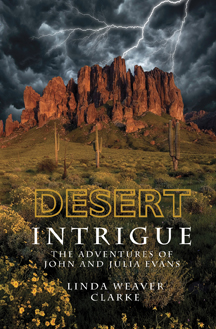
The mystery behind Superstition Mountain was the inspiration for Desert Intrigue. When Julia’s brother announces that his dude ranch is haunted, she believes that someone is trying to sabotage his place and force him to sell. The mysterious happenings have to do with Superstition Mountain, the lost Dutchman’s goldmine, and the great Thunder God. Is it possible that the legend of the Thunder God is actually true? After a terrible thunderstorm, everyone begins to wonder. John and Julia quickly head to Mesa, Arizona and discover a few mysterious events. Will they find out who is behind these disasters before Uncle Kelly’s dude ranch is ruined?

“I loved the first three books in this series, but I actually loved this one even more,” wrote Socrates Book Reviews. “I didn’t think that was possible. The characters are so well written and I absolutely adore each member of the Evans family. They grab at your heartstrings and won’t let go. As for the story, talk about a fast-paced story. Desert Intrigue is that and more! It’s a book that will leave you with that warm fuzzy feeling. Linda Weaver Clarke has outdone herself with this book! I’m sure it comes as no surprise that it’s getting my Socrates’ Great Book Alert.”

From a man’s viewpoint, Rick Estep wrote: “As a guy, it was really great to see a man, check that men, being shown as strong not only physically, but emotionally as well. I’ve read a lot of books where the guy in the book isn’t shown as being connected to his wife/girlfriend through anything other than surface thoughts. With John and his brother-in-law Kelly, though, I saw them as men’s men, and ones that also were invested in the life of the women around them. The story moved quick enough, there were plenty of red herrings to keep me guessing, right down to the ending of the book.”

“Desert Intrigue is an entertaining and joyful book, my favorite in this mystery series by Linda Weaver Clarke. I love the sparks of romance in this adventure–they spice things up and add much interest to the story. The book has a handful of surprises that I did not anticipate, and the mystery fuels much of the action.” —Suko’s Notebook

This book can be purchased at Audible audiobooks at: https://www.audible.com/pd/Desert-Intrigue-Audiobook/B07ZG557KD

You can buy this series from Amazon at any of the links below.

Author Linda Weaver Clarke: https://lindaweaverclarke.wordpress.com/cozy-mysteries.

Cozy Mystery Blog: https://cozymysteryseries.wordpress.com

Audiobook Blog: https://familyfriendlyaudiobooks.wordpress.com

My Website: http://www.lindaweaverclarke.com/purchasebook.html

Ancient America, Writing and Arts

Does Montezuma’s Treasure Really Exist?

Montezuma’s treasure has been on people’s minds for ages. The question is, does it really exist? When Cortez arrived in Mesoamerica in the early 1500s, Montezuma thought he was the Great White God who had promised to return one day. It didn’t take long for Montezuma to realize that he had made a mistake. Cortez was a cruel man and began treating the Aztecs abominably. The king, for his own reasons, refused to fight Cortez, but the people had had enough and decided to rebel.

After a great and terrible battle, the Spanish conquistadors were driven back, away from Tenochtitlan, Mexico. During this rebellion, Montezuma was killed. While the Spaniards were taking care of their wounded, the Aztecs quickly bundled up their treasure and took off with it. They had to protect it with their lives because it was sacred. For years, they kept the treasure in honor of their God when he returned. It was estimated at around $10,000,000 worth of gold and jewels.

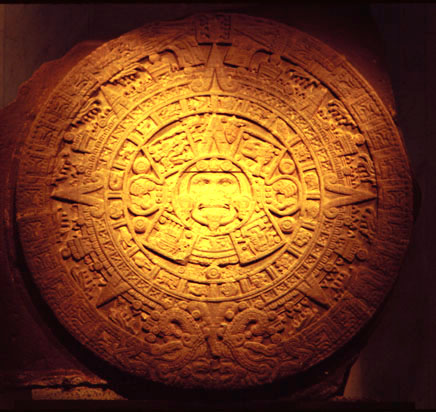
In 1519, Cortez’s chronicler, Bernal Diaz, recorded what he saw in the village: “All the riches of the world were in that room.” Diaz said that he saw a golden wheel in the form of a sun that was as big as a cartwheel with pictures engraved upon it. There was a silver one, which was an imitation of the moon, and golden statuettes in the shape of jaguars. When Cortez finally won the battle and entered the room where the treasure was kept, he found nothing. After searching the whole village, he found a few small statues, which had been thrown in the lake. Apparently, the Aztecs tried to hide what they didn’t take with them. The archeologists figured the rest had been transported faraway where Cortez would never find the treasure.

The search for Montezuma’s treasure has intrigued many people. In 1914, an old prospector by the name of Freddy Crystal had a newspaper clipping of Anasazi art. It was a photograph of a petroglyph engraved on the side of a cliff located in Johnson Canyon, not far from Kanab, Utah. The petroglyph was similar to the etchings on a treasure map he had found years earlier. After searching the canyon for two long years, he left and returned in 1920 with another map he had obtained in Mexico. It was a copy of a four hundred year old maguey map that he found in a depository of a Mexican monastery.

Maguey is a fibrous plant that is cultivated in Mexico. Years ago they used it like paper and it lasted for centuries. Freddy said that he met a descendant of Montezuma who gave his interpretation of that map. It showed a canyon with seven mountains: four mountains to the north, one on the east side, one on the west, and another on the south. That described the topography of Kanab, Utah. The petroglyphs matched his first map, and the topography matched his second map. The map showed steps on the side of a mountain and marshland below. White Mountain just happened to have steps carved into the sandstone that ascended more than one hundred feet. The only exception was the marshland, which didn’t exist. According to Freddy, marshlands dry up so he began his search for the treasure.

Knowing it was a big task, he promised to share the treasure with all the townsfolk of Kanab if they helped him dig and search for it. For the next two years, at the bottom of White Mountain, a large tent city was created and townsfolk went everyday to help Freddy search for the gold. It was an exciting time for everyone. All the stores and businesses would shut down every day so they could dig.

The town of Kanab was unlike any other town in the United States. They had elected a mayor and a city council of all women, something unusual in 1920 because the eastern states did not recognize women’s rights yet. It was the first petticoat government in all of history. In fact, these good women made sure the county court opened and closed with prayer every time they met. A petticoat government! How awesome is that?

When the townsfolk agreed to help Freddy, Kanab’s city council voted to not have any publicity about the treasure because they didn’t want the word to spread. If that happened, people from all over the country would invade their little town. So if anyone uttered the word “treasure,” they were fined.

After much digging, they found a cave with a series of rooms. They actually found tunnels with booby-traps but no gold. Three boulders almost killed Freddy as they fell to the ground. He claimed they had been set on purpose by the Aztecs. When no gold was found, they figured the Aztecs had moved the treasure to another spot. After everyone gave up, Freddy left and never returned.

Every now and then someone will find the “Aztec Treasure Sign” but no treasure. Many tribes believe that the treasure is protected. Legend says that after hiding everything from Cortez, the tribe designated certain guardians to protect the treasure. If someone gets too close, they will do everything in their power to protect it and quickly move it to another spot. Many Native Americans believe their spirits still guard it today. Where is Montezuma’s treasure? Is it hidden among the Utah Mountains?

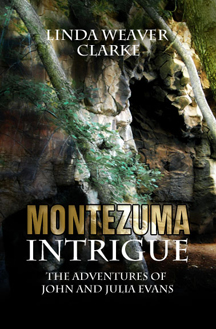
This subject was so intriguing to me that I sat down and began writing Montezuma Intrigue. This book is about mysterious events, the search for Montezuma’s treasure, a good-looking rogue, and family secrets. When a leather parchment of Montezuma’s map is found in great-grandfather Evans’ old chest, April and the twins know this summer is going to be a memorable one. With Julia’s help, she and the girls convince John to go on a treasure hunt. Does Montezuma’s treasure exist? Whatever the case, John insists on keeping their little treasure hunt a secret. If certain people find out about it, the family could be in danger. While searching for Montezuma’s treasure, Matthew is trying to find the courage to tell April how he feels about her. How does he tell his kindred friend that she means more to him than just a friend?

“I am charmed by Montezuma Intrigue. The mysteries continue as this author entrances us with life-like characters and electrifying adventures. The search for Montezuma’s treasure is both exciting and memorable. There are also a few romances, and some surprises as well, which kept my reading pleasurable and lively. I enjoyed the adventure and suspense in her latest novel, which kept me reading well into the night.” –Susan Ortlieb, Suko’s Notebook

“The whole Evans family is back for another wild and dangerous adventure,” wrote Socrates Book Review. “This time they have Grandpa along for the ride. As the search begins, Julia’s father tells the family of how he met their grandmother. A story he never told anyone before… not even Julia. The family is enraptured by his tale and eager to learn more about their family’s history, but the story comes to a crashing halt when their lives are threatened by treasure seekers. This story mixes adventure, suspense and romance into one captivating story.”

This book can be purchased at Audible audiobooks at: https://www.audible.com/pd/Montezuma-Intrigue-Audiobook/B07W6RWXBL

You can buy this series from Amazon at any of the links below.

Author Linda Weaver Clarke: https://lindaweaverclarke.wordpress.com/cozy-mysteries.

Cozy Mystery Blog: https://cozymysteryseries.wordpress.com

Audiobook Blog: https://familyfriendlyaudiobooks.wordpress.com

My Website: http://www.lindaweaverclarke.com/purchasebook.html
Ancient America, Writing and Arts

The Mystery of the Mayan Ruins

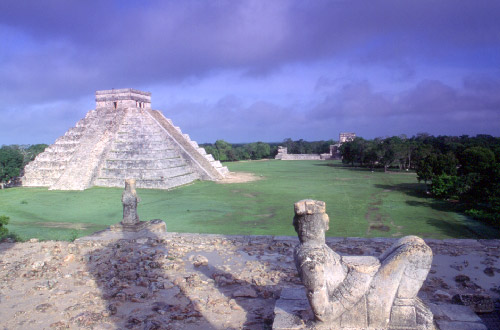
Chichen Itza

Researching the Mayan ruins was such fun and very intriguing. I needed to know some Mayan history before I could write my next novel, which would be a Suspense Mystery. Did you know that not one pyramid-type structure on this American continent reaches an apex like the Egyptian pyramids? The tops were cut flat and a sacred building was placed on top. In Egypt, the pyramids were used as burial tombs, but in America they were used to worship God. Since they were built for religious purposes, they call them Mayan Temples.

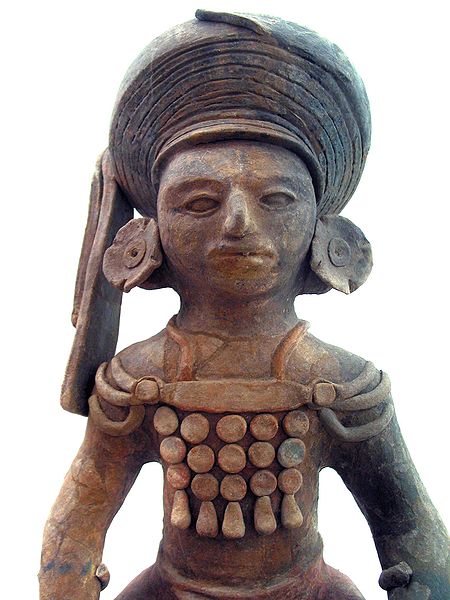
Scientists have found both Hebrew and Egyptian influences in Mexico. It’s puzzling, but it’s true. Dr. Marett, an archaeologist, excavated a tomb at Monte Alban in Mexico. He found two five-foot-tall stone carvings. One carving was Hebrew art and the other was Egyptian. They were both made from the same material and found in the same tomb. There are Egyptian and Hebrew influences here in America.

Dr. Spinden of Peabody Institute and Dr. Morley of Carnegie Institute deciphered the writings on a stone found in that region. What they discovered was amazing. Dr. Spinden wrote, “With records cut in imperishable stone, the Mayas suddenly made their appearance upon the historical scene on August 6, 613 B.C. Why on August 6, 613 B.C.? Where were the Mayas on August 5th? Nobody knows.” (Spinden, Ancient Civilizations of Mexico and Central America. Page 12.) Since there were no land migrations, such as tracks or markings left behind, Dr. Spinden was confused where they had come from.

An archaeologist by the name of Hyatt Verrill had heard about a “Golden Book” that the Mayans claimed to have. He wrote: “According to tradition, a complete history of the Maya was recorded in the Golden Book of the Mayas which, if it actually existed, as it probably did, was so carefully hidden to prevent it from falling into the hands of the Spaniards that it never has been found.” (Verrill, America’s Ancient Civilizations.) To his great surprise, plates of gold were found among the ruins in a cenote, which is a deep sunken hole full of water.

In one of the Indian legends, they say that a White Bearded God appeared to them from the sky and taught them to be wise as serpents and harmless as birds. As I learned about the Mayan culture, I was intrigued by their belief in God and their intelligence. Shortly before the White Bearded God appeared to them, there were “frightful earthquakes” and “volcanic fires” that struck fear into the Mayan people. Here are a few quotes from scholars, archaeologists, and historians that they got from Mayan history.

“The sun and moon were eclipsed, the earth shook and the rocks were rent asunder, and many other things and signs happened. This was in the year CeCalli, which, the chronology being reduced to our system, proves to be the same date when Christ our Lord suffered, 33 A.D.” (Bancroft, Native Races. Vol. 5, Page 210.)

“The land was shaken by frightful earthquakes, and the waves of the sea combined with volcanic fires to overwhelm and engulf it. Most of the inhabitants were destroyed.” (Baldwin, Ancient America. Page 176.)

“The lava swept down from Mt. Ajusco in some cataclysm, covering many square miles of territory to a depth of thirty or forty feet and burying such villages as chanced to lie in its path.” (Spinden, Ancient Civilizations of Mexico and Central America. Page 49.)

After all this destruction, Mayan history says the White Bearded God appeared. With determination, the Mayans rebuilt their cities and roads and began anew.

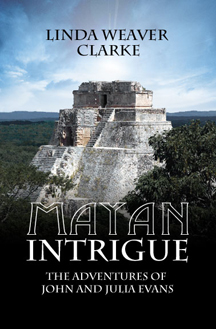
In Mayan Intrigue, the discovery of a priceless artifact puts Julia’s life in great danger. While on assignment for the newspaper, John and Julia Evans try to enjoy a romantic vacation among the Mayan ruins. When Julia sees a couple of suspicious men exchanging an item, she quickly turns and leaves but it is too late. The men have seen her. Before John and Julia realize what is going on, they are both in danger and find themselves running for their lives through the jungles of the Yucatan.

Mayan Intrigue has a blend of humor, romance, and suspense. This story is based upon the adventures of a married couple and their three daughters. While John and Julia are following some leads in Mexico, their daughters decide it’s time to retaliate when some fraternity boys pull a prank on a few coeds. The girls are infuriated at the way the boys treat their friends. It’s Payback Time.

“This is an exciting follow-up to Linda Weaver Clarke’s Anasazi Intrigue,” wrote Socrates Book Review. “She takes us through Cancun and we get to visit the Mayan ruins. Ms. Clarke’s descriptions easily transport the reader to Mexico. You really feel as if you are part of the story. Her words flow beautifully through each page of the book. Readers learn more and more about the beautiful relationship shared by John and Julia. Their commitment to each other is stronger than ever.”

“What starts out as a romantic trip quickly turns into a dangerous adventure among the Mayan ruins and jungles, and the vacationers are on the run from thieves–and wild animals! Excitement prevails! This book is full of mystery and suspense. Linda’s writing is lively and down-to-earth; she has the ability to make you feel as if you’re in these stories, along with John and Julia, trying to decipher the truth and escape from harm.” –Suko’s Notebook

Mayan Intrigue is available on Amazon and Audible.

Ancient America, Writing and Arts

The Mystery Behind Artifact Theft

Ancient American artifacts are being sold to the highest bidder. When an ancient ruin is discovered, it doesn’t take long for thieves to find out about it.

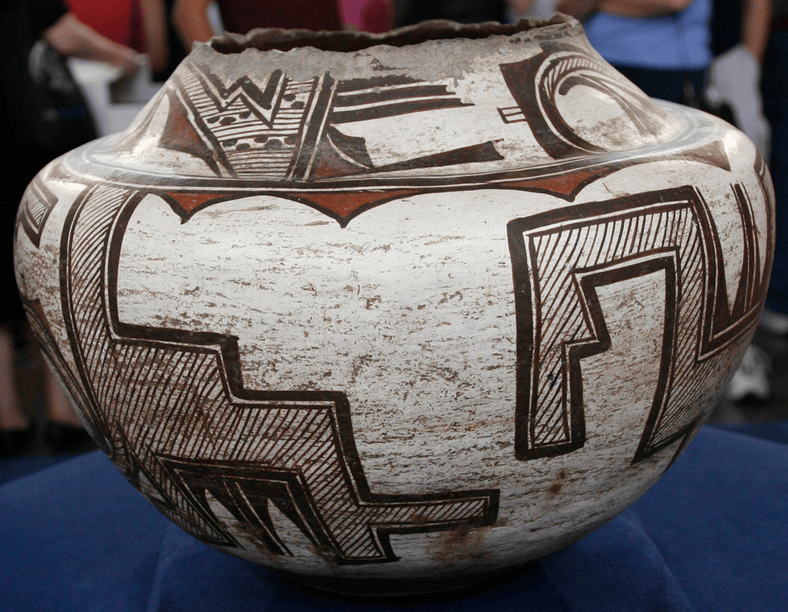
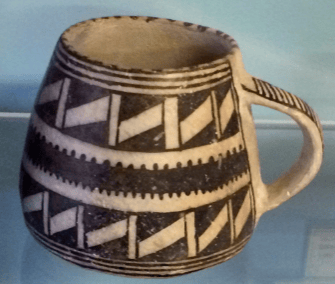
Archaeological thievery is becoming more and more of a problem every year. Theft at the Four Corners area of Utah, Colorado, New Mexico, and Arizona is a big problem. Ancient dwellings, petroglyphs, and pottery are part of Anasazi history and it is being sold to the highest bidder.

Sadly, an ancient funeral pit can be sold for as high as $60,000 on the black market, not to mention pottery, baskets, and pendants found by looters. The Las Vegas Sun Newspaper told about two men who were loading some artifacts in the trunk of their car. A ranger saw what they were doing and questioned them, not realizing he had accidentally stumbled upon the largest operation in the area. The men were arrested and they recovered more than 11,100 relics.

Archaeological theft has gone corporate. They even pay rent on private property in order to dig without being caught. When an ancient ruin is discovered, it doesn’t take long for thieves to take it apart.

Native American culture isn’t the only one being stolen. How about the Mayan culture? Thieves can loot a sacred temple in a few days. Not long ago, the authorities recovered thirty-nine artifacts that were being hawked at a stand on the side of the road in Hidalgo. It was believed they were stolen from the Teotihuacán pyramids near Mexico City. Not only that, but the United States Customs officials found fourteen artifacts that a tourist was trying to smuggle across the border. He was going to ship them to an art dealer in New York. Some of the artifacts were estimated to being at least two thousand years old.

Did you know that looting is only second to selling illegal drugs? Since organized crime has taken over, there is an increase of violence. A guard at one of the sites in Belize saw a bunch of looters dressed in guerrilla uniforms, and they were armed with AK-47 assault rifles. He was not about to stop them, so he quickly disappeared up a tree and kept quiet until they left.

Archaeological thievery is becoming more and more of a problem every year. Did you know that artifacts are being sold online on eBay? It’s true. The ancient past is being sold to the highest bidder. What is the best way to preserve a culture? Maybe if we know about the laws and help protect the past then we can make a difference.

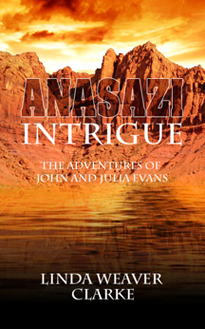
As I researched this subject, I learned to appreciate the archaeologists and what they’re doing out in the field. They’re helping us learn about the ancient past. This subject was so intriguing to me that I sat down and wrote my next two books. In these mystery/suspense novels called Anasazi Intrigue and Mayan Intrigue, Julia Evans is a reporter and it doesn’t take long until she realizes the story she is pursuing is much bigger than she thought. Before John and Julia realize what is going on, they are both in danger and find themselves running for their lives through the jungles of the Yucatan.

The Book Connection reviewed Anasazi Intrigue and wrote: “John and Julia Evans are a married couple with grown children. It’s nice to see a romantic element to a story that involves mature adults and a marriage that is not perfect, but one in which both people are committed to making it work. Add to that their grown children, a friend of the family, and a group of interesting bad guys, and you have a recipe for a great read.”

Socrates Book Review wrote about Mayan Intrigue: “You really feel as if you are part of the story. Her words flow beautifully through each page of the book. Readers learn more and more about the beautiful relationship shared by John and Julia. Their commitment to each other is stronger than ever.”

Anasazi Intrigue is available on Amazon and Audible.

Mayan Intrigue is available on Amazon and Audible.

Find out more about “The Challenge of Writing a Mystery” on my blog at https://lindaweaverclarke.wordpress.com/2021/09/02/the-challenge-of-writing-a-mystery.