

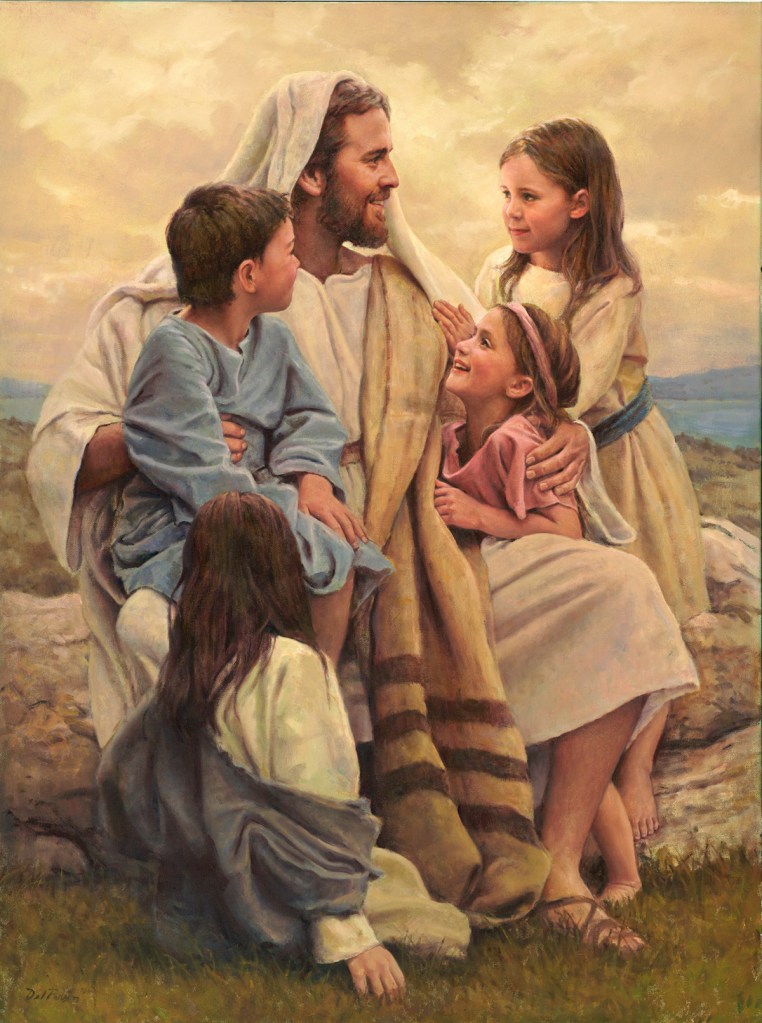
Easter is a very important Christian holiday. It is a time when all Christians celebrate the Resurrection of Jesus Christ. He is the foundation upon which all Christian religions are built. Jesus taught his followers a higher law, to love one another and to turn the other cheek. His message was one of peace and to help those in need. Richard L. Evans said, “Jesus is the Christ, the divine Son of God, our Lord and Savior, the Messiah, the Prince of Peace.”
According to the Gospels in the New Testament, Pontius Pilate who was a Roman authority arrested Jesus and questioned him. To the great surprise of his followers, Pilate sentenced Him to death. His disciples were devastated and shocked. He was the Son of God. How could this happen to him? Why did it happen?
Russell M. Nelson explains: “He was willing to suffer for the sins and weaknesses of each of us, which suffering caused Him to bleed at every pore.”
In the New Testament, John says: “Greater love hath no man than this, that a man lay down his life for his friends.” (John 15:13)
Some believe that Pilate crucified Jesus because the Romans viewed him as a threat to the empire. Others believe the Jewish Authorities, the Pharisees and Sadducees, pressured him because they were jealous of Jesus and what He represented.
After His death, Jesus was taken down from the cross and placed in a sepulcher, which was provided by a friend. Three days later, Jesus appeared to Mary Magdalene and then to His disciples. When they saw Him, they didn’t realize he had been resurrected and thought He was a spirit.
Jesus said, “Behold my hands and my feet, that it is I myself: handle me, and see; for a spirit hath not flesh and bones, as ye see me have.” (Luke 24:39)
Mark E. Petersen said, “He broke the bands of death to provide a resurrection for us all. His atonement was the most important event that ever happened.”
Easter is not only in celebration of the Resurrection of Jesus Christ but of all mankind. It meant that everyone would be reunited with their bodies after death. Easter is a celebration of life.
Thomas S. Monson described the real meaning of Easter when he said, “Frequently, death comes as an intruder. Death lays its heavy hand upon those dear to us and leaves us baffled and wondering… How I pray that all who have loved then lost might know the reality of the Resurrection and have the unshakeable knowledge that families can be forever.”
As we celebrate each year, we decorate the chapels with white lilies, which are symbols of life. What do Easter eggs represent? Early missionaries decided to use eggs as a tool to describe Jesus Christ’s resurrection. It symbolized the tomb where the body of Jesus was placed, reminding Christians that Jesus overcame death and was resurrected.
They would color the eggs yellow, blue, and red. They told the children that yellow represented the resurrection, blue represented love, and red represented the blood of Christ. They also painted Bible scenes on the shells and hid them for the children to find. When an egg was found, the child was supposed to tell the story that was painted on the egg.
One of the earliest Easter egg hunts recorded traces back to Martin Luther. Some Christians celebrate by rolling Easter eggs down a hill. It was symbolic of the large stone that was rolled away from Christ’s tomb.
How does the Easter bunny fit in with Easter? It doesn’t. It actually comes from folklore. It represents spring. Rabbits symbolize prosperity, abundance, fertility and new life. Some historians believe the legend of the bunny is between 400 to 500 years old.
So why do Christians celebrate Easter? It reminds us that Jesus suffered for our sins and was resurrected for all mankind.
Watch He is Risen video and learn why Easter is so important.


This is wonderful, Linda. Thanks so much. Your text is accurate and the video so poignant. Keep up the good work, my friend. Colleen
A believer in Christ’s unmistakable miracles, I feel that Jesus was/is meant to prove to people that there really was/is hope for the many — especially for young people living in today’s physical, mental and spiritual turmoil — seeing hopelessness in a fire-and-brimstone angry-God-condemnation creator requiring literal pain-filled penance for Man’s sinful thus corrupted behavior (somewhat like an angry father spanking his child, really). He became incarnate to show humankind what Messiah ought to and has to be. Fundamentally, that definitely includes resurrection.
Still, I need to realize some, for lack of more befitting terminology, higher meaning/function to Christ’s great suffering and death than payment in lieu of what humankind owes but could never manage to pay up. Unlike decades ago, I can no longer embrace the widely accepted belief that the Creator plainly required such painful, and maybe even bloody, suffering recompense. To me, payment is really a human trait/desire, and I perceive the Almighty as being way, way beyond and better than human. [To be clear, though, I’m not saying all of this lightly, especially with it being Easter.]
However, I do believe there is a very important place/function for immense suffering within/for Christianity, notably that of Christ’s apostles. They travelled across vast, hazardous territories to testify to witnessing his miracles, especially his defeating death twice (including Lazarus). And, as is pretty well known, a number of apostles suffered horrific deaths because of their faith, fates I very much doubt they would have willingly suffered — Batholomew was skinned alive — had they believed Jesus actually was a false messiah, a lie, and in fact dead. It is this that mostly enables me to keep my own faith.