

Music has been part of life for centuries and has a therapeutic effect on people. In the Bible, David played the harp to soothe King Saul when he was upset or depressed. Singing and dancing were also ways to praise God. In Psalm 149 verse 3, it says: “Let them praise his name in dance: let them sing praises unto him.”
As early as the 15th century, folk music became popular in the European countries. The lively Country Dance of the Scottish and English became part of their culture. When the Irish converted to Christianity, it was reported that dancing became more popular among the people. Celtic dancing was soon born and it was a way of entertaining and celebrating. This sort of dancing set them apart from other cultures.
Music and dancing brings great joy to many. We have the Polka, the Virginia Reel, the Foxtrot, the Tango, the Samba, the Charleston, the Swing, and the Waltz. But none were as badly received as the Waltz was. It had a rocky beginning and wasn’t accepted as readily as other dances. In fact, it was severely criticized. It was considered a German folk dance and was created in the 18th century.
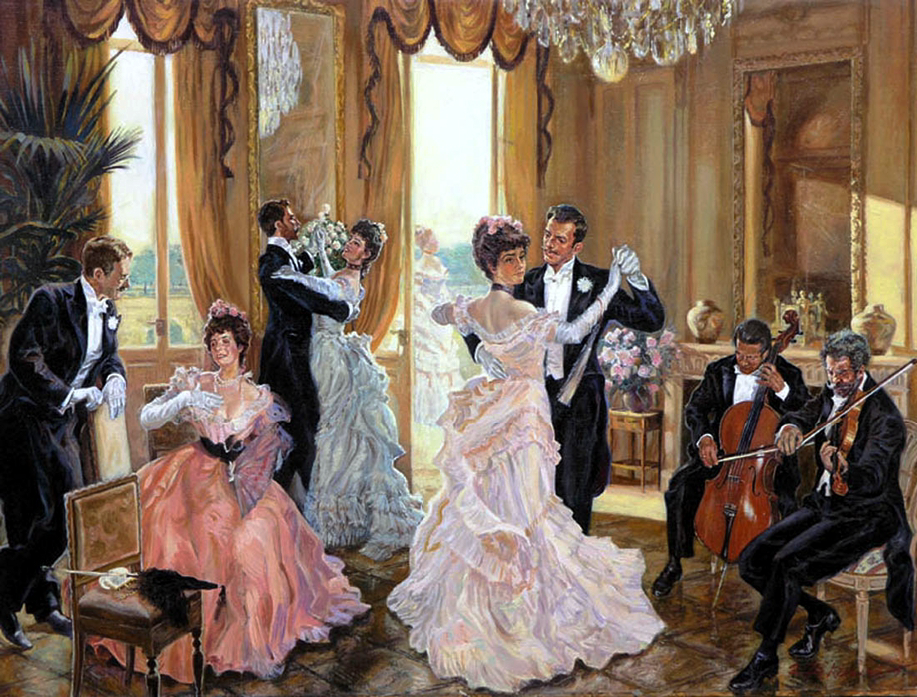
Most dances were rigid, had strict rules to follow, and everyone danced at arms-length. But the Waltz was completely opposite from other dances. It was “free form” dancing where you held your partner in a closed position. With the man’s arm wrapped around the lady’s waist and pulling her close, they danced almost cheek to cheek. It was quite popular among the peasants but high society denounced it when they heard of embracing one’s partner. The upper classes claimed that it was immoral behavior.
The Oxford English Dictionary called the Waltz “riotous and indecent.” In a 1771 German novel, an aristocrat was upset about the “newly-introduced waltz.” The guest said: “When he put his arm around her, pressed her to his breast, cavorted with her in the shameless, indecent whirling-dance of the Germans and engaged in a familiarity that broke all the bounds of good breeding—then my silent misery turned into burning rage.”
The Waltz was popular in Germany, Austria, and Vienna but its popularity spread to other countries with the introduction of the Strauss waltzes at social gatherings. Soon the Waltz got the attention of bored noblemen and they would sneak out and join the country-dances. Even though they enjoyed it, they didn’t want to overstep the bounds of propriety so they kept it a secret.
In The Times of London, 16 July 1816, it said: “We remarked with pain that the indecent foreign dance called the Waltz was introduced (we believe for the first time) at the English court on Friday last … to see that it is indeed far removed from the modest reserve which has hitherto been considered distinctive of English females… We feel it a duty to warn every parent against exposing his daughter to so fatal a contagion.”
When it was finally introduced in the United States, their reaction wasn’t any different than England. After years of dancing at arm’s length, it was not readily accepted and received much criticism. In 1834, Lorenzo Papatino introduced a new waltz to the Americans. It was called the Boston Waltz. It was much slower than the German waltzes and not as boisterous. The youth absolutely loved it.
When my daughter was going through some old newspaper clippings that her grandmother had saved through the years, she found an article about such dancing. There was no date or name of the newspaper, but this is what the clipping said:
The Reverend G. W. Simpson has uttered a strong denunciation of dancing in a letter to his parishioners. “Many think that there is very little harm in dancing, and I entirely agree. If only we had the right style of dancing; but, unfortunately, a style of dancing has been introduced into this country during comparatively recent times—I refer to the Waltz and kindred dances—which in many cases cannot but excite the animal passions, and affords abundant opportunities for undue familiarity.”
It took many years before the new dance was accepted into society. Inspired by a tender dream I once had, I decided to create my new historical romance called: One Last Dance.Felicity Brooks is a talented artist but her career is cut short when her father passes away. Realizing the importance of family, she travels home to care for her mother. When Felicity meets their new neighbor, a fine-looking bachelor, she soon discovers that he is hiding his true identity. Nicholas Adams is on a quest. But that is not all. When she finds out that someone is after a valuable heirloom…a precious treasure that her father had discovered in his attic, her life takes a new turn. After realizing how much she misses her father, will one last dance heal her broken heart?
Watch a sweet romance blossom before your eyes in One Last Dance.
This book is available on Amazon and Audible Audiobooks.

