Newsy Articles, Writing and Arts

Medicines and Healing Ointments of the Past

It is interesting to learn what our grandparents and great grandparents did when they were sick or just had a bug bite. The remedies were quite ingenious… ideas I never thought about doing when I felt miserable. Today we just grab a bottle of aspirin for pain, fever, or muscle aches. Although, if you take too much aspirin, it’s hard on your stomach and can cause ulcers. So what did our ancestors use instead of aspirin?

If they had a fever or a terrible migraine headache, Feverfew was recommended. It is commonly known as Cornflower. This lacy daisy-like flower could be seen in anyone’s yard. Many refer to it as “Bachelor’s Buttons.” Why was it given this nickname? Young men would tuck this dainty flower in the buttonhole of their jacket as a symbol that he was single and available to the young ladies.

If your child came home crying because he had an insect bite, there was a remedy. Just smear honey onto the wound every hour to help bring down the swelling and ease the pain. It’s sort of a sticky way of relieving pain but it’s oh-so sweet!

Those who had trouble sleeping would take Chamomile Tea before going to bed. It helps with anxiety and to fall asleep easier. It also reduces inflammation related to arthritis or menstrual cramping. I’ve tried it for arthritis and it works. I’m quite impressed. Just recently they found that it prevents osteoporosis.

How about colds and a sore throat? If someone had a sore throat, a salt-water gargle was recommended. My favorite, though, is what my mother always did. She would put a tablespoon of honey and a tablespoon of vinegar in a glass of warm water for me to sip slowly. It did the job and relieved my sore throat.

If a person was congested, it was common to place a Castor Oil compress on the person’s chest to help them breathe easier. If a child had a hard time breathing or was struggling for breath, they used Ipecac to clear the airways of phlegm.

Indigestion or a sour stomach was easy to cure. They didn’t use Tums. My mother would give me a glass of milk to drink. It worked every time. Another cure is a teaspoon of baking soda in water.

If the patient had an ailment the doctor couldn’t figure out or didn’t have an answer, he would say: “A hot bath always works wonders. I would recommend soaking for a half hour every day until you feel better.”

Deep wounds are something to be worried about because infection can set in so easily. That can be very dangerous for the patient. My great grandmother was quite knowledgeable when it came to herbs and “doctoring” her own children. Once a neighbor begged her to help her husband because a bull had gored him in the abdomen. She instantly went to his aid. After cleaning the wound, she made a liniment of arnica burrs steeped in alcohol. Then she saturated a cloth with the ointment and applied it to the wound. For the next few weeks, she rewrapped his wound with fresh ointment until he was healed. It worked and he never got infection.

After learning about all these wonderful medicines of the past, I wanted to create a historical romance with the main character as a doctor and use all these remedies. In my research, I found that the Kentucky’s Medical Department of Transylvania University was a popular school to attend for an education in medicine. It was perfect because my story was to take place in southern Illinois, not far from Kentucky.

In Angel’s Serenade, Emmeline Scott is raising her sister’s two children and is surprised when she finds out the new doctor in town is helping her nephew adapt to his surroundings. It is not easy to be uprooted and have to start a new life. Each day when Emmeline practices the piano, she doesn’t know the doctor secretly sits on his porch to listen to her music. As Emmeline gets to know the charming doctor, Lucas Golden, they become intrigued by her neighbor’s mysterious behavior. Will they discover his secret? And who is the leader of the River Pirates, who is causing so much havoc?

Watch a sweet romance blossom before your eyes in Angel’s Serenade.

This book is available on Amazon and Audible Audiobooks.

Newsy Articles, Writing and Arts

Music and Dancing Uplifts the Soul

Music has been part of life for centuries and has a therapeutic effect on people. In the Bible, David played the harp to soothe King Saul when he was upset or depressed. Singing and dancing were also ways to praise God. In Psalm 149 verse 3, it says: “Let them praise his name in dance: let them sing praises unto him.”

As early as the 15th century, folk music became popular in the European countries. The lively Country Dance of the Scottish and English became part of their culture. When the Irish converted to Christianity, it was reported that dancing became more popular among the people. Celtic dancing was soon born and it was a way of entertaining and celebrating. This sort of dancing set them apart from other cultures.

Music and dancing brings great joy to many. We have the Polka, the Virginia Reel, the Foxtrot, the Tango, the Samba, the Charleston, the Swing, and the Waltz. But none were as badly received as the Waltz was. It had a rocky beginning and wasn’t accepted as readily as other dances. In fact, it was severely criticized. It was considered a German folk dance and was created in the 18th century.

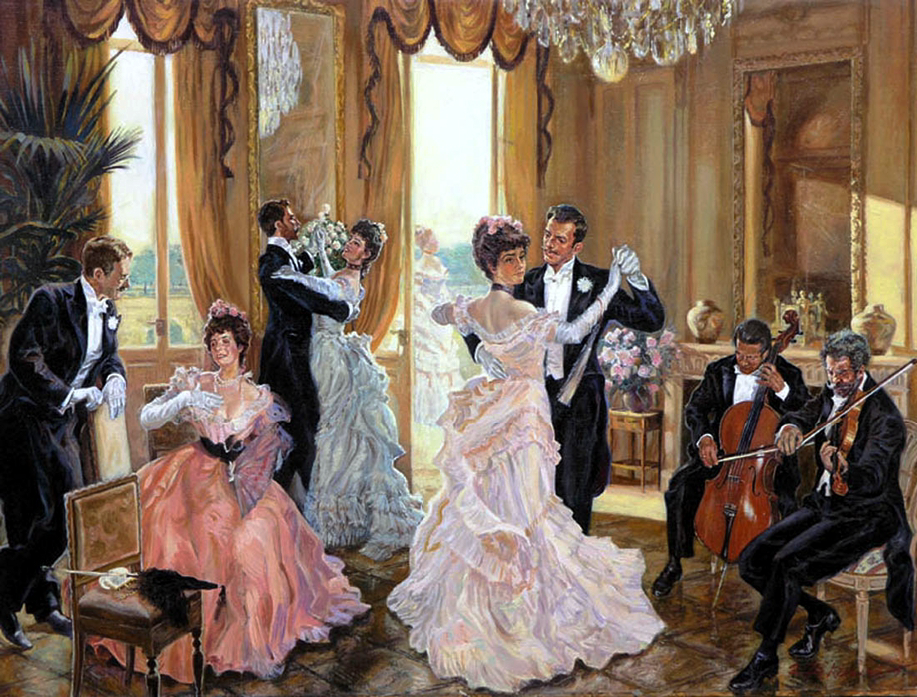
Most dances were rigid, had strict rules to follow, and everyone danced at arms-length. But the Waltz was completely opposite from other dances. It was “free form” dancing where you held your partner in a closed position. With the man’s arm wrapped around the lady’s waist and pulling her close, they danced almost cheek to cheek. It was quite popular among the peasants but high society denounced it when they heard of embracing one’s partner. The upper classes claimed that it was immoral behavior.

The Oxford English Dictionary called the Waltz “riotous and indecent.” In a 1771 German novel, an aristocrat was upset about the “newly-introduced waltz.” The guest said: “When he put his arm around her, pressed her to his breast, cavorted with her in the shameless, indecent whirling-dance of the Germans and engaged in a familiarity that broke all the bounds of good breeding—then my silent misery turned into burning rage.”

The Waltz was popular in Germany, Austria, and Vienna but its popularity spread to other countries with the introduction of the Strauss waltzes at social gatherings. Soon the Waltz got the attention of bored noblemen and they would sneak out and join the country-dances. Even though they enjoyed it, they didn’t want to overstep the bounds of propriety so they kept it a secret.

In The Times of London, 16 July 1816, it said: “We remarked with pain that the indecent foreign dance called the Waltz was introduced (we believe for the first time) at the English court on Friday last … to see that it is indeed far removed from the modest reserve which has hitherto been considered distinctive of English females… We feel it a duty to warn every parent against exposing his daughter to so fatal a contagion.”

When it was finally introduced in the United States, their reaction wasn’t any different than England. After years of dancing at arm’s length, it was not readily accepted and received much criticism. In 1834, Lorenzo Papatino introduced a new waltz to the Americans. It was called the Boston Waltz. It was much slower than the German waltzes and not as boisterous. The youth absolutely loved it.

When my daughter was going through some old newspaper clippings that her grandmother had saved through the years, she found an article about such dancing. There was no date or name of the newspaper, but this is what the clipping said:

The Reverend G. W. Simpson has uttered a strong denunciation of dancing in a letter to his parishioners. “Many think that there is very little harm in dancing, and I entirely agree. If only we had the right style of dancing; but, unfortunately, a style of dancing has been introduced into this country during comparatively recent times—I refer to the Waltz and kindred dances—which in many cases cannot but excite the animal passions, and affords abundant opportunities for undue familiarity.”

It took many years before the new dance was accepted into society. Inspired by a tender dream I once had, I decided to create my new historical romance called: One Last Dance.Felicity Brooks is a talented artist but her career is cut short when her father passes away. Realizing the importance of family, she travels home to care for her mother. When Felicity meets their new neighbor, a fine-looking bachelor, she soon discovers that he is hiding his true identity. Nicholas Adams is on a quest. But that is not all. When she finds out that someone is after a valuable heirloom…a precious treasure that her father had discovered in his attic, her life takes a new turn. After realizing how much she misses her father, will one last dance heal her broken heart?

Watch a sweet romance blossom before your eyes in One Last Dance.

This book is available on Amazon and Audible Audiobooks.
Newsy Articles, Writing and Arts

Did Women Freely Give Their Opinions in the 17th Century?

The 17th century was a time of great change. Art, music, dance, and poetry became more elaborate and dramatic. During the 1600’s, differences of opinion were discussed and argued about between the Catholics, Protestants and other denominations. But were men the only ones who freely gave their opinion?

There were some women throughout history who spoke up for their beliefs but most were not taken seriously. When a woman spoke in public, it was considered “unwomanly.” But that didn’t stop my ancestor, Dorothea Scott.

Dorothea was of a spiritual nature and had a strong belief in God. She was a countess from Kent, England and married Major Daniel Gotherson. I learned that she was brought up as a Protestant, but she felt something lacking so she joined the Quakers. Feeling the need to bring people to God, she wrote a book named A Call to Repentance and it was published in 1661. Then she promptly took it to King Charles II as a gift, hoping to bring about more righteousness. This copy is in the Library of The Society of Friends, Devonshire House, in London. Then she went about preaching the gospel and gained a large following. They referred to her followers at Scott’s Congregation.

On March 4, 1655, a relative reported that Dorothea was giving lectures about religion and felt it was disgraceful. That was a man’s duty and not a woman’s. She wrote: “As for the countess, I can tell you heavie news of her, for she is turned Quaker and preaches every day on a tubb.” (This letter is in the Bodleian Library at Oxford.)

In her journal, Dorothea wrote: “Then began I to be led by the Spirit of God out of darkness into His marvelous light … and where I have known Him most is too hard to be uttered.”

This was just the beginning for women to stand up for what they believed. In the late 1700s, Abigail Adams, the wife of John Adams who was the second president of the U.S., encouraged her husband to “remember the ladies” as they made their new laws. She believed in women’s rights, women’s education, and was against involuntary servitude. It was said that he respected her opinions and she advised her husband in several decisions.   

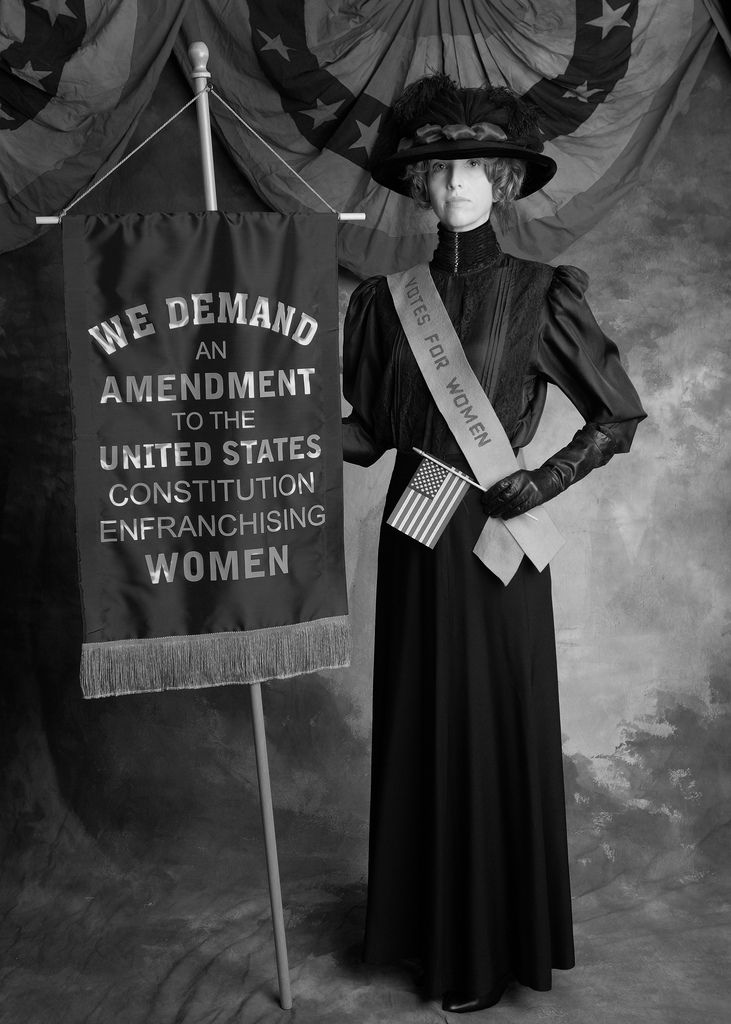
During the 1800s, more and more women spoke up and let their opinions be heard. When these women took a stand, their actions were looked down upon. Speaking publicly was considered improper for a woman. Even though it wasn’t accepted, Elizabeth Stanton still gave her opinions. Both she and her husband were abolitionists. When they went to a convention in England that was against slavery, she tried to give her opinion but was put down and told that women were not permitted to give speeches or their opinions. It was solely a man’s place to speak publicly. That experience made her all the more determined to speak out for what she believed.

Susan B. Anthony was another who spoke out against inequality. She encouraged women to stand up for their rights. And that was exactly what she did and was arrested for it. On November 5, 1872 in a presidential election, the authorities were summoned and Susan B. Anthony was arrested for voting illegally. When she was fined $100, she refused to pay it. Susan said firmly, “Resistance to tyranny is obedience to God.”

Eighteen years later, one state after another began allowing women to vote. The first four states were Wyoming (1890), Colorado (1893), Utah (1896), and Idaho (1896). In fact, Wyoming and Utah actually gave women the right to vote before they were states and when they were just territories. Women in these states immediately began running for office and won the vote.

These courageous women were an important part of history but that was just the beginning. It wasn’t until March 22, 1972 that the Equal Rights Amendment was passed by the U.S. Senate and it was sent to the states for ratification. In this amendment, women were not to be discriminated against when it came to jobs or equal pay.

This subject was the inspiration for my new book, A Mississippi Sunset. In this historical romance set in 1844, Laura McBride is a liberated and courageous young lady who is convinced that she can help others in her crusade for equality. She encourages women to fight for their beliefs and be heard. But she soon finds out that women who speak publicly are looked down upon. But that wasn’t how Deputy William Davies felt. When he met Laura McBride, he was intrigued with her independent nature. He admired her spunk and determination to fight against slavery and involuntary servitude.

Watch a book trailer of the Women of Courage series on YouTube.

A Mississippi Sunset is available on Amazon as a paperback, ebook, and as an Audible Audiobook narrated by Elizabeth Schmidt.

Amazon: https://www.amazon.com/Mississippi-Sunset-Women-Courage-ebook/dp/B09SRDBHNX

Newsy Articles, Writing and Arts

Education for Women in Nineteenth Century America

In America, not many girls received an education in the early nineteenth century. Those who did only received the basic classes of reading and writing. A few women’s schools were created for the advancement of women’s education such as the Troy Female Seminary in New York, established by Emma Hart Willard in 1821. It was the first female school in the United States that provided young women with the same college education comparable to that of young men.

In Great Britain, education for women was viewed as a way of helping the young women become better wives and mothers. Their classes included music, Latin, and all the social graces including etiquette. Some of the higher-class society taught their daughters mathematics and sciences along with their brothers.

Sydney Beveridge, of the Oxford University Press, wrote: “In both the black and white populations, women were less likely to be literate than men, but the gender gap in literacy rates was wider among whites. 59.5 percent of illiterate white adults were female.”

It wasn’t until the 1840s that women’s education was taken seriously and educational opportunities for young women opened up. Soon, there were opportunities for women to become teachers. Some taught in the frontier where it was greatly needed and others taught in the big cities.

In the early days of America, religion was an important part of education in schools. The school board believed that religion was “the foundation of all that is truly great and good.” In other words, the Bible was to be part of the school curriculum. In the 17th and 18th centuries, they always began with a prayer and read from the Bible before studying other subjects. Some philosophers believed American children were more literate than the Europeans because of the need to read the Bible.

Dr. Charles Aebi said, “The Bible itself was used for learning to read and for reading in the schools; the ABCs were learned by use of Bible names like A is for Adam, B is for Boaz, C is for Caleb, etc. Bible passages were selected to be read based on level of vocabulary. Bible stories and principles were taught… and Bible principles were emphasized by memorizing the ten commandments.”

In the 1600s and 1700s the Bible was very important for teaching people to read, no matter what age. When I was in grade school, they didn’t teach from the Bible but the teacher always began with a prayer and the pledge of allegiance to the flag.

Even though there were schools in most communities, there were those who never attended because of lack of money or opportunities. Some women had to sign an X to a wedding certificate because they had never learned to sign their name. In 1870, it was noted that twenty percent of the adult population was illiterate. Sadly, placing an X on a document was not uncommon.

When I learned that my great grandmother, who was from Wales, received a formal education in a private school, I was impressed. Not many could afford that kind of an education in the 1800s. Her aunt paid for her education because she believed it was important for her niece to be educated. When my great grandmother came to America at the age of seventeen, the young men referred to her as “a lady of refinement.”

After learning about her many experiences when she arrived in America, I was so impressed. Thus, I was inspired to write my next book, which I called A Lady of Refinement. In this historical romance, Serenity’s brother William questions someone who is thinking about courting his sister.

Cocking his head curiously, Jonathan asked, “What makes you think she’ll turn me away?”

“Let me put it this way,” said William. “Serenity has a formal education from a private school. What kind of education do you have?”

Jonathan shrugged. “A fair one.”

“Just fair? All right, can you sign your name to a document?”

He nodded. “Yes. But it’s not very legible. Some say it’s hard to read, sort of like chicken scratches.”

William chuckled. “Serenity writes with an elegant hand, Jonathan. It’s like art. You’ll need to work on that. Can you read?”

“Yes. But not very well. I probably need to work on that, too.”

“That’s encouraging. When she first arrived in America, Serenity was shocked to find so many adults who didn’t know how to read or how to sign their name. They would have to put the mark of an X for their signature. An education is important to her.”

“Do you have any suggestions?”

He nodded. “As a matter of fact, I do. You just might have a chance. Serenity teaches an evening class three times a week at the local school, from seven o’clock to eight-thirty. She teaches adults how to read and write. Sign up for her class and show Serenity how interested you are in education. That should get her attention.”

As he gave some thought to the idea of bettering his education, Jonathan asked, “Do you really think that will work?”

So there you have it! A Lady of Refinement is the second book in the Women of Courage series that tells of courageous women who make a difference in their community, taken from true experiences.

A Lady of Refinement: Serenity teaches reading and writing to adults. She wonders if anyone can measure up to the heroes in her books. But the adventures soon become real after arriving in America.

When Jonathan meets Serenity, an educated and courageous woman from Wales, he becomes intrigued with her and wonders how he can win her heart. Her brother gives him some advice, but Jonathan begins to question his wisdom. Should he trust his friend or is he leading him astray?

Watch a book trailer.

This book is available on Amazon and Audible at https://www.amazon.com/Lady-Refinement-Women-Courage-ebook/dp/B09PHZK76M

Newsy Articles, Writing and Arts

Chocolate Lovers and Chocolatiers

Did you know that chocolate is good for you? Not only mentally but health-wise? Research shows that chocolate has many benefits for the health of your heart, cognitive function, and helps with iron deficiency. Especially dark chocolate! If you’re a milk chocolate lover, it still helps.

In a controlled trial, it was found that eating dark chocolate daily for 30 days actually improved cognitive functioning such as learning, reasoning, thinking, and it improved the memory. Wow! I like those benefits. The researchers said it had something to do with “methylxanthines” in chocolate.

For those who may have iron deficiency, dark chocolate is a great source of iron. If you are low in iron, you may have fatigue and don’t have much energy to do your daily chores. But no worries! Fifty grams of dark chocolate has six milligrams of iron. If you have anemia, it is a great excuse to eat a chocolate bar daily.

But that’s not all! If you want a healthy heart, eat chocolate. Both dark and milk chocolate have cacao, which contains flavonoids. What are flavonoids? It helps to improve the health of your heart. Dark chocolate has a higher percent of cacao, though, because it is richer in flavonoids.

This next part may astound you. Chocolate is rich in magnesium. What is magnesium? It relaxes muscles that are tense. This is great news for women because it eases the pain of menstrual cramps. This may be the reason why many women crave chocolate. For those who have wives that are miserable during this time, give them a chocolate bar. Of course, dark chocolate has more milligrams of magnesium than milk chocolate. If you’re not a dark chocolate fan, milk chocolate is just fine when craving a treat.

I learned that chocolate was invented in the spring of 1765. Dr. James Baker and John Hannon who was an Irish immigrant made their first batch of chocolate by grinding cocoa beans between two massive circular millstones. After pouring the chocolate syrup into an iron kettle, they poured the liquid into molds to cool into blocks of chocolate. Soon the word spread that Baker and Hannon had a factory that produced chocolate bricks. The customers would shave strips of chocolate into boiled water to make cocoa syrup.

During the American Revolution, they struggled to keep the business going since they had to get the beans from the West Indies. In 1779, Hannon disappeared when he went on a voyage to the West Indies to buy more cocoa beans. With all these trials, Baker kept the business alive until the 1790s when he handed the family business over to his son Edmund. After a time, he in turn handed it over to his son Walter.

It was Walter who decided it was time to hire two young women to work for him. In 1834, Mary and Christiana Shields worked hard and helped his business grow. They were the first women Chocolatiers in America.

It was such fun to learn about the beginnings of chocolate and hot chocolate drinks. In my historical romance, The Light at the End of the Tunnel, Hannah is a chocolatier. It was her desire to own her own business. When she was questioned about a woman owning a business, this was her response.

Glancing at her shop, Thomas said, “It’s not easy opening your own business. Especially if you’re a woman. There’s a lot to take into consideration before plunging into such a thing. Do you know what you’re getting yourself into?”

“Don’t worry about me,” she said firmly. “I’ve done my research.”

When he raised his brow, Hannah knew that she had surprised him with such a curt answer. But she was so tired of defending herself and convincing everyone that she could make her own living. The last thing she wanted to do was work as a maid for the rest of her life.

Folding his arms over his broad chest, he asked, “What’s the name of your business and what are you going to sell?”

“I’m calling it: Hannah’s Hot Chocolate.”

So there you have it! The Light at the end of the Tunnel is the first book in a series called Women of Courage. This series tells of courageous women who make a difference in their community.

The Light at the end of the Tunnel  is about Hannah, a young single mother, who wants to make something of her life by opening a hot chocolate shop. She soon finds that starting her own business isn’t as easy as she thought. But she will not give up. She has had some hardships since arriving in America. But the trials in her life only make her stronger.

When Thomas finds out that Hannah’s shop is struggling, he comes to the rescue with a clever plan. Will she agree to such an unconventional idea? Can he convince her to find room in her heart for one more person?

Watch this Book Trailer and get in the mood of chocolate.

Check out this historical romance on Amazon or at Audible Audiobooks at https://www.amazon.com/Light-End-Tunnel-Women-Courage-ebook/dp/B09JHRQYF1

Newsy Articles, Writing and Arts

Women Doctors and Bobbed Hair Were Not Acceptable

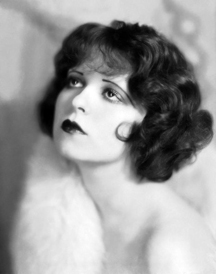
Once again I am amazed at the different things I learn while doing a little research for one of my historical novels. While writing Elena, Woman of Courage, I did some research for the 1920s, which was the time period of my novel. In this new era, women openly expressed their opinions and wanted to be heard. The roaring twenties was a time of jazz, the raising of hemlines, sleek skirts, long beads down to the waist, and bobbed hair. The youth loved the new styles but the elderly shook their heads in despair. What was this new generation coming to?

Bobbing ones hair was the new style but it caused a lot of commotion and discontent. When a teacher in Jersey City decided the style was adorable and bobbed her hair, the school board ordered her to grow it back. The board said that women wasted their time fussing around with the bobbed hairstyle, and the teacher would be fired if she didn’t grow it back. At one prestigious department store, women who bobbed their hair and raised their hemlines were actually fired. In the newspaper, they reported that a preacher pounded the pulpit, saying that a “bobbed woman was a disgraced woman.” I even read that it caused many a divorce.

But that wasn’t the only time women had to fight for their rights. During the 1800s, young women were supposed to prepare for marriage and think about raising a family. They had private tutors and were taught needlework and the rules of etiquette. Most were not expected to get an education beyond high school. Some didn’t think it was necessary and others did not have the money to send their daughters to a university. But there were some families who sent their daughters to college and wanted them to be educated. I soon discovered that women were not allowed to get a degree in some fields of education, though. Some degrees were strictly for men.

Elizabeth Blackwell disagreed with the university’s rules. She was a very determined woman who challenged those rules. She wanted to get an education in medicine and help those less fortunate. What was her desire? She wanted to become a doctor. Unfortunately, women could not get a medical degree but that did not stop her. She had a dream and was bound to make that dream come true.

When Elizabeth entered college, she demanded her rights. The Geneva Medical College in New York felt that women should get their education in the degrees specified for women and would not budge. After much coercion and putting pressure on the university, the school board finally gave in. It wasn’t because they believed in her. They did it as a joke and to teach her and other women a lesson. They figured she would fail miserably and thereby let all women know that it was not a woman’s place in society. But Elizabeth fooled the university president and the faculty. She graduated at the top of her class. It surprised everyone.

Elizabeth Blackwell became the first female doctor in the United States. After her graduation in 1849, she sadly found that no hospital would hire her because she was a woman. But this did not stop her. Elizabeth organized her own clinic in New York and helped many people. But that was not all. She opened a medical college for women where they could have the opportunity to get an education in the medical field.

In 1850, Lydia Folger Fowler was the second woman who graduated with a medical degree at Central Medical College in Syracuse, New York. She was the only female graduate that day. After her graduation, the college appointed her as the Principal of the Female Department and also a Professor of Midwifery and Diseases of Women and Children, making her the first female Professor of Medicine in the United States. Lydia was the first American-born woman to become a doctor in America whereas Elizabeth was born in England and later on went back to England to continue her medical practice. These two women made history with their determination to get a degree in medicine.

It wasn’t easy on a family financially to send a daughter to college. Most families sent their sons to college first so they could provide for a family later on. When I found out that my grandmother graduated from college with a nursing degree in 1904, I was grateful that her father was so supportive. In her autobiography, she mentions the many lives that she saved and helped bring into this world during her lifetime.

After my research, I created a historical romance with plenty of humor. Elena, Woman of Courage takes place during the Roaring 20s. It was a time of great change. Women raised their hemlines and bobbed their hair. When Elena Yeates settles into a small western town as the newest doctor, a few problems arise. The town is not ready for a female doctor, let alone one so strong and independent. She must struggle against the prejudice to establish her new practice. As she fights to prove herself, the town’s most eligible bachelor finds it a challenge to see if he can win her heart.

Watch the Book Trailer below.

Elena, Woman of Courage can be purchased through Amazon and Audible Audiobooks.
Available as an audiobook at Audible: https://www.audible.com/pd/Elena-Woman-of-Courage-A-Family-Saga-in-Bear-Lake-Idaho-Volume-5-Audiobook/B07JJJS87W

Available as an eBook and paperback on Amazon:

https://www.amazon.com/Elena-Woman-Courage-Family-Volume/dp/1481266799

#historicalromance

#audibleaudiobook

#roaringtwenties

#sweetromance

Newsy Articles, Writing and Arts

The Amazing Ice Palace and the Elusive Butch Cassidy

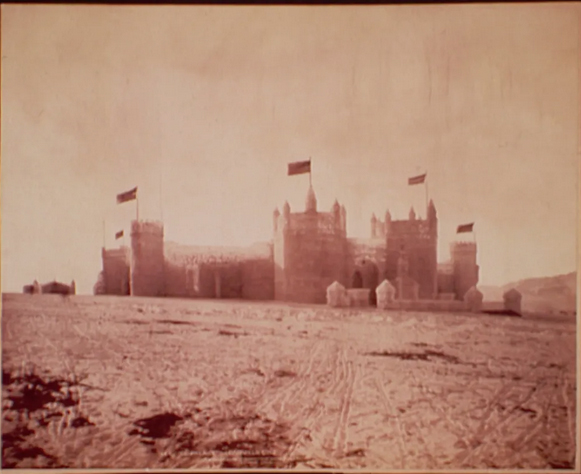
I am always amazed at the different things I learn while doing a little research for one of my historical fiction novels. I did some research for the year of 1896, which was the time period of my novel. It was so intriguing to find out that an Ice Palace had been built in Leadville, Colorado at that time and people from all over the country traveled there to see this magnificent sight.

In order to draw tourists to this mining town, the citizens decided to build a huge tourist attraction. So they hired Architect Charles E. Jay, who had designed an ice castle in Saint Paul, Minnesota. With the help of around 250 men, they began their project on November 1, 1895 to construct the palace. It was made of five thousand tons of ice blocks formed into the shape of a magnificent palace, which stood on five acres of land. Its towers were over 90 feet tall by 40 feet wide, and the palace measured at over 58,000 square feet.

After 36 days, it was completed. As a finishing touch to this palace, the walls were sprayed with water in order to freeze the blocks together so they wouldn’t come apart. To add a glow to this storybook world, it was illuminated with electric lights that sparkled against the ice block walls. In the daytime, the sun shone against the ice, making the walls sparkle. Inside the palace were several rooms. There was a gaming room, a restaurant, an ice rink, a ballroom, a theatre, toboggan runs, and a carousel house.

On January 1, 1896, the Ice Palace was opened for business. The word spread quickly and the local railroads promoted the attraction by giving special rates to its customers. More than 250,000 visitors attended between January and March. Admission into the palace was fifty cents for adults and twenty-five cents for children. In March of 1896, this magnificent palace began melting. The last event that was held there was a maypole skating party on May Day. That was such an interesting bit of history.

Since my book takes place in Bear Lake Valley in Montpelier and Paris, Idaho, I did some research about that area. I learned some interesting facts about Butch Cassidy, a notorious outlaw, who had robbed the Montpelier Bank in 1896. Local Bear Lake Historian Pat Wilde wrote Treasured Tidbits of Time, telling about the details of that bank robbery.

Butch Cassidy was an interesting fellow. He referred to himself as the “Robin Hood of the West,” taking from the rich and giving to the poor. Cassidy actually wrote, “The best way to hurt them is through their pocket book. They will holler louder than if you cut off both legs. I steal their money just to hear them holler. Then I pass it out among those who really need it.” He proclaimed that he was fighting for the settlers’ rights against the rich cattle baron.

Every year, Montpelier puts on a reenactment of the bank robbery for the public, exactly how it was described by the banker. Picture this scene as it was recorded.

Four men entered the building with sober faces. The two in front were the Bank President and his friend who had been chatting on the steps outside the bank. Behind them were two men dressed like cowhands. As they entered, the men in front stiffened and the fear in their eyes was obvious. The only people in the bank were a woman stenographer and a male teller by the name of Mackintosh. As one of the cowboys closed the door behind them, everyone could see a gun pointed at the banker’s back.

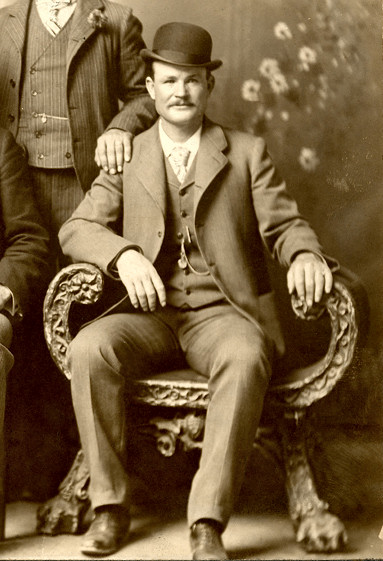
It was interesting to find out that Butch Cassidy was born in Utah and was raised by religious parents. When he was a teenager, he went astray and left home to ride with the outlaws, taking on the name of his mentor. Cassidy was known for his charm and quick wit, not to mention his fearlessness and bravery. He had an air of authority about him and no one could mistake that he was the leader of The Wild Bunch.

His partner in crime, Elza Lay, was a tall, slender, handsome man known for being a top bronco rider and ranch hand. He was a flirtatious sort of fellow and seemed to have a way with women and horses. Outside the bank was a third partner. Meeks was holding the horses and waiting across the street.

Elza Lay casually pointed his revolver at his hostages while Cassidy quickly scooped up the money into a gunnysack. To their surprise, there was only $7,000 in the bank. Cassidy held the gunnysack in a casual manner and slowly walked outside, closing the door behind him. He walked nonchalantly across the street as if he did not have a care in the world. After fastening the gunnysack to his saddlebags, he climbed upon his horse and rode slowly away. No one seemed to take notice of the stranger or suspect anything was wrong as he rode down the street and out of town.

Everything was planned down to the last moment. Cassidy apparently never acted without a well-staked-out plan. After he was out of town, Meeks moved across the street toward the bank with the remaining horses and left Lay’s horse standing in front of the bank. Then Meeks climbed on his horse and slowly rode away. Once again, no one took notice of the second stranger riding down the road.

Through the bank window, Lay watched Meeks ride out of town. It was now his turn to leave. After closing the door to the bank, he quickly hopped on his horse and headed down the street.

When Mr. Gray, the Bank President, ran outside and alerted everyone, it seemed as if all pandemonium erupted. Deputy Fred Cruikshank took off on his bicycle for home so he could saddle up his horse. Attorney Bagley followed after him, while Sheriff Jefferson Davis called for a posse.

Watching all the activity in town, Macintosh figured the “thirteenth” was the cause of it all. You see, it happened on the thirteenth day of the month. It took place after the thirteenth deposit had been made in the amount of thirteen dollars. And the robbery transpired at thirteen minutes after three o’clock.

So what do you think? Did it happen because of the unlucky number 13? And did Butch Cassidy get away? He and his gang were never caught.

Page One Literary Book Review wrote about Melinda and the Wild West: “Linda Weaver Clarke displays an easy and excellent style of writing, blending adventure, romance, history, humor and courage. Melinda and the Wild West is an instant classic and should put this author on the literary map all over the world.”

Melinda and the Wild West can be purchased through Amazon and Audible Audio Books.

Audible Audio Books: https://www.audible.com/pd/Melinda-and-the-Wild-West-The-Award-Winning-Original-Version-Audiobook/B07M62GL6S