The writing of love notes to someone for Valentine’s Day has been popular since the 1700s. Many people made their own Valentines to give to a loved one. In the 1820s, special stationary was sold for Valentine greetings and was popular in the United States and Great Britain. In the 1840s, Valentine cards were finally created. They were sheets with embossed borders and illustrations that could be folded and sealed with wax.
The New York Courier in1830 wrote a humorous article about Valentine’s Day and picking a husband or wife at this time. It said: “We have ascertained the fact that the bachelors are moving around the city and actually making preparations for the celebration of St. Valentine’s Day. They have positively crawled out of their flannels, trimmed their whiskers, shaved the growth of ages, straightened the vertebrae, and bound them up in cloaks ten yards wide to keep the cold weather at a distance during the approaching festival. We give the ladies fair warning to hold themselves in readiness. The picked youth of the city, such as will make loving husbands, are to be present, if God prosper them.”
This article made me laugh. I love holidays, especially in fictional stories. One of my books is a Collection of Six Holiday Stories. Each story is fun and full of surprises. The first story is about Valentine’s Day. The Valentine Bandit has struck again. Each year he sneaks out of his hiding place and finds some poor unsuspecting widow to surprise. He is spreading happiness throughout the city of Willow Valley. Many a young girl wants to meet this bandit, but he is too sly to be caught. Reports say he has a black mask just like a bandit and is dressed all in black. Valentine’s Day is a day to show that we care about others, and this bandit is doing just that.
Check out Holidays in Willow Valley below and see what you think. Then read about other holidays, as well. Happy Valentine’s Day, everyone! I hope you have a great week.
This book is vailable as an eBook in Kindle Unlimited, as a Paperback, and as an audiobook.
February represents love and romance. It’s a special time when you can show your sweetheart that you care, no matter what age you are. How long has Valentine’s Day been around and why do we celebrate it? There are a few speculations how it came about.
Around the year 270 A.D., Claudius, a Roman Emperor, proclaimed that single men made better soldiers and outlawed marriage for these young men. But Valentine knew this was not right and defied the new law by performing marriages for the young soldiers in secret. Valentine was also known for helping the Christians escape Roman prisons and persecution. When Valentine was discovered, Claudius arrested him and he was put to death on February 14th.
For his undying love to God, Valentine was named a Saint. All the stories I have read about him represent a man who has a strong belief and faith in God. He is heroic and romantic, doing what he believed was right. Thus, every year on Valentine’s Day, the writing of love notes and giving gifts to someone became popular.
The writing of love notes and making cards for Valentine’s Day became popular in the 1700s. In the 1820s, special stationary was sold for Valentine greetings. In the 1840s, Valentine cards were sold with embossed borders and illustrations. You could fold it, seal it with wax, and mail it to a loved one. In the wealthier society, gift giving was popular for Valentine’s Day.
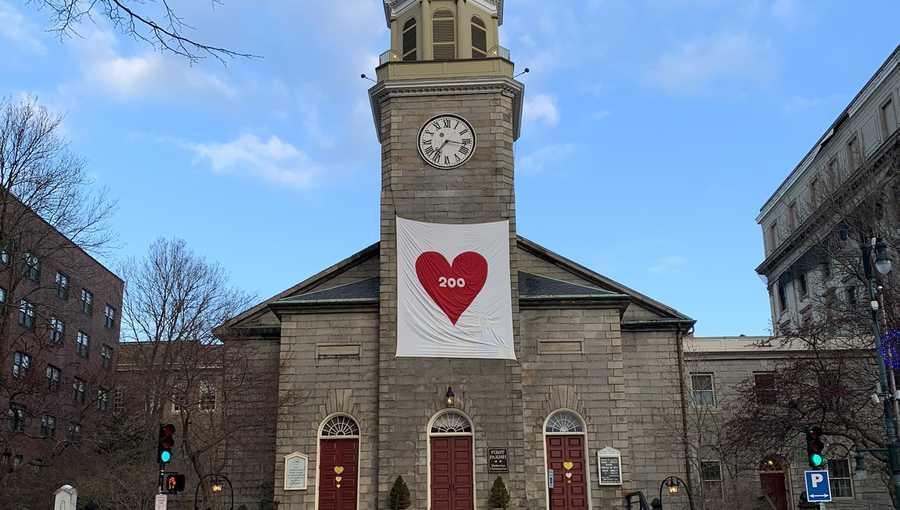
There are many unique ways to show love. Have you heard of the Valentine Bandit? For the past 35 years, a Valentine Bandit has been spreading love to the community in Portland, Maine on Valentine’s Day? No one knows who he is and the bandit wants to keep it that way. He is showing love and good cheer among the citizens, as he hangs valentines and banners around town. It’s his way of reminding everyone that love is important.
As he spreads joy to the community, everyone wonders who he is. Young women wonder what he looks like… if he is handsome and charming. Children wait excitedly for his appearance. The elderly are surprised and touched by his generosity. Who is this mysterious bandit? I wonder how he spreads all this joy throughout Portland without anyone seeing him?
With several holidays coming up one after another, we get excited to celebrate each one. Have you ever wondered how each of our holidays came about? Who created the traditions we have today? After much research for a historical fiction called Holidays in Willow Valley, I learned some very interesting facts.
Let’s begin with February: Valentine’s Day! Have you ever wondered how long Valentine’s Day has been around? In 1375, English Poet Geoffrey Chaucer first talked about Valentine’s Day as a day of love in one of his poems. But why was it celebrated?
One legend says that Valentine was a priest in Rome. When Claudius proclaimed that single men made better soldiers and outlawed marriage for these young men, Valentine knew this was not right. So he continued performing marriages for the young soldiers in secret. When Valentine was discovered, Claudius arrested him and he was put to death. There are other stories that say Valentine was killed for helping the Christians escape the Roman prisons. According to History.com, they said, “Although the truth behind the Valentine legends is murky, the stories all emphasize his appeal as a sympathetic, heroic and—most importantly—romantic figure.”
The writing of love notes and making cards for Valentine’s Day became popular in the 1700s. In the 1820s, special stationary was sold for Valentine greetings. In the 1840s, Valentine cards were sold with embossed borders and illustrations. You could fold it, seal it with wax, and mail it to a loved one. In the wealthier society, gift giving was popular for Valentine’s Day. You always gave a gift to someone you loved or admired.
Next, we move onto March: St. Patrick’s Day! Did you know St. Patrick’s Day is a religious celebration? The man who introduced Christianity to the Irish was a Saint by the name of Patrick. While teaching them the gospel in Ireland, he compared the three-leaf clover to the Father, the Son, and the Holy Ghost. To us it’s just a clover, but to the Irish it’s referred to as a Shamrock. In honor of St. Patrick, they display a Shamrock in their homes and on their clothing.
Leprechauns are part of the celebrations, as well. As you know, a leprechaun is short and has a red beard, but he didn’t originally wear green. He wore a red jacket, vest, and hat. As time passed, his colors changed to green. It is the desire of every young girl and boy to catch a leprechaun. If you catch him, he has to grant you three wishes. Some say that if you catch a leprechaun, he has to give you three wishes. If you caught a leprechaun, what would your three wishes be?
Next is April Fools Day. It is a time where anyone is allowed to lie, deceive, and do pranks on anyone and hopefully get away with it. How long has this “foolish” day been around? In 1698, a British newspaper wrote: “Yesterday being the first of April, several persons were sent to the Tower Ditch to see the lions washed.” In 1708, the BritishApollo Magazine wrote: “Whence proceeds the custom of making April Fools?”
That is a very good question. Some historians say it started back in 1582, when France switched calendars. The Julian calendar said April 1 was the start of the New Year because of the spring equinox. But the Gregorian calendar chose January 1. Those who didn’t know the start of the New Year was moved to January 1 and celebrated it during the last day of March through April 1 were made fun of and called “April Fools.” Some pranks included having a paper fish placed on one’s back, referring to him as an April fish. Why an April fish? A young and easily caught fish was a gullible person.
History.com wrote: “There’s also speculation that April Fools’ Day was tied to the vernal equinox or first day of spring in the Northern Hemisphere, when Mother Nature fooled people with changing, unpredictable weather.”
In 1839, The Baltimore Sun reported an April Fools joke in the paper. Apparently, a husband woke his wife in the early hours of the morning and told her that the nursemaid was knocking at their door, saying their baby was very ill. When she found no one at the door, he laughed and called her an “April Fool.” The husband reported to the paper, “She put me in mind of a locomotive letting off steam. In the torrent of her passion, she poured the contents of a water bottle over me, and thus emptied the phials of her wrath.”
How about May Day? The Celts celebrated this holiday on May 1st, welcoming in a change of the season. It was celebrated with bonfires that symbolized the return of life and fertility to the earth. A popular tradition was dancing around the Maypole that was covered with ribbons. The day was full of merriment and festivities. It was a day to gather together and celebrate life.
The Maypole Dance didn’t last long in America because the Puritans discouraged everyone from celebrating the holiday. They felt it was a worldly custom. Although, Americans did continue to celebrate with baskets full of sweets and flowers, which they hung on the doors of their friends on May 1st.
How do we celebrate May Day today? Spring flowers are gifted to friends. Sometimes it’s a secret and only a note is left in the basket. In some of the schools, teachers will have the children decorate a May Pole with ribbons and flowers. Then the girls will dance around it, holding onto one of the ribbons as they wind it around the pole.
Next we have July:Independence Day. The Declaration of Independence was written on July 2, 1776 and it was approved on July 4. August 2 was the official signing of the document. The following year on 1777, the first celebration of Independence Day was held, six years before America won its freedom. The patriots knew this war meant liberty and would not give up.
As the years passed, it was common to have fireworks, parades, concerts, bonfires, the firing of cannons, and the reading of the Declaration of Independence. The tradition of celebrating the Fourth of July became even more popular and widespread after the War of 1812, when Americans once again had to fight for their liberty against Great Britain. They did not take it for granted any longer but realized how precious freedom was.
The patriotic song, My Country, ‘Tis of Thee, was sung in public for the first time on July 4, 1831 at the Park Street Church in Boston. In 1870, Independence Day was an official unpaid holiday. In 1938, it became a paid federal holiday.
In the month of October, we celebrate Halloween. The English, Irish, Scotch and Welsh immigrants brought this tradition to America during the mid-1800s. It was called All Souls’ Day and has deep Catholic roots. It was a time to remind people of their mortality and the importance to pray for the souls of their kindred dead who were in purgatory. The celebration began in the evening of October 31st, which gave its new name All Hallows Eve – Halloween. The festivity lasted until Nov 1st. This was a time to honor the dead. It was celebrated with bonfires and everyone dressed up in costumes such as saints, angels, devils, or animals.
The community would meet together and have bonfires to ward off bad luck and evil spirits. They celebrated by telling ghost stories, playing games, and making mischief. The following day the ashes were spread over their gardens for good luck. This was also a time for finding one’s future husband and wife. If you dropped a strand of your hair into the bonfire, the identity of your spouse would be revealed in a dream. “May fate reveal by candle’s gleam your own true love on Halloween?”
It was tradition to put a candle inside a carved-out turnip. When the immigrants came to America, they found there were not many turnips, so they started using pumpkins. And so a new tradition came about! They began carving faces in pumpkins and put candles inside.
Next is November:Thanksgiving! George Washington wanted to make Thanksgiving a national holiday, but some of the congressmen were against it. Thomas Jefferson especially didn’t like the idea. Unfortunately, the idea brought a lot of discord because many felt the hardships of just a few Pilgrims did not warrant a national holiday. Thanksgiving was only celebrated intermittently until Abraham Lincoln was president. In 1863, he officially proclaimed the last Thursday in November as a National Day of Thanksgiving, saying it should be a day of “thanksgiving and praise” to God.
Did you know that James Pierpoint composed a song in 1857 especially for Thanksgiving called One Horse Open Sleigh? It was so popular that everyone started singing it for Christmas, and the name was changed to Jingle Bells in 1859.
December: Christmas! The most beloved of holidays is Christmas. Itwasn’t always celebrated in America as it is today. There was a time when it was actually outlawed. The Puritans and English separatists believed celebrating the birth of Jesus Christ was disgraceful and disrespectful because the people would get drunk, gamble, and be riotous. A 16th-century clergyman, Hugh Latimer, wrote, “Men dishonor Christ more in the twelve days of Christmas than in all the twelve months besides.”
The Puritans had a great deal of influence, so celebrating Christmas became a crime and you were fined or arrested if you were found celebrating. It was banned until the 1680s. For many years afterwards, the New England Puritans continued to boycott Christmas. In 1856, Henry Wadsworth Longfellow wrote about New England: “The old Puritan feeling prevents it from being a cheerful, hearty holiday; though every year makes it more so.”
Since Americans were free to celebrate Christmas, we celebrated the birth of Jesus Christ by having a feast. We didn’t have Santa Claus, Christmas trees, and mistletoe in America. So how did we get these traditions? Who influenced Americans to celebrate Christmas? The Dutch brought St. Nick to America and the Germans brought the Christmas tree to America, but we didn’t incorporate it into our lives until the late 1830s and 1840s.
It wasn’t until Clement Moore wrote his famous poem that Americans took notice of these traditions. Twas the Night Before Christmas introduced St. Nicholas, giving gifts, and flying reindeer… ideas we hadn’t heard of before. Gift giving caught on quickly because of his poem. It was published in 1837 under the name of A Visit from St. Nicholas. A Christmas Carol was another book that had an influence on Americans, which was written in 1843. It changed our way of celebrating Christmas.
Is this your new site? Log in to activate admin features and dismiss this message