

Part 3
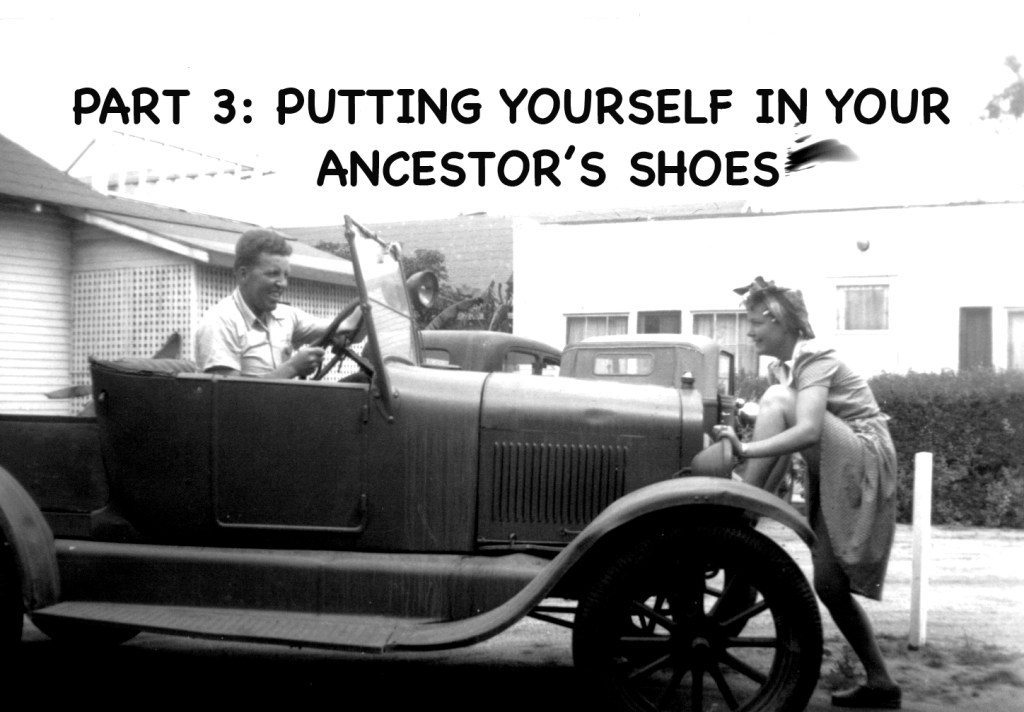
Putting Yourself in Your Ancestor’s Shoes
Adding emotion to your story is very important. If you don’t weep while telling a tragic story, then begin again. If you don’t laugh during a hilarious incident, then write it again. You need to touch the hearts of your readers. How do you do that? By adding emotion and describing how you or your ancestors must have felt. It’s important to add feelings of fear, frustration, anger, etc. If you’re writing your own story, tell how you felt.
Fear: My knees shook, my heart beat rapidly, I trembled.
Anger: My face turned red, I clenched my jaw, I stomped my foot.
Frustration: I threw my hands in the air, I shook my head with frustration and said…
Love: Your children would love to find out how you felt about their father when you first met.
Here is an example of showing fear in my father’s biography. “Once Marcus came up with a terrific idea. His sisters, Frances and Edith, stayed home from church one evening because they were feeling sick. Around 9:00 pm, he snuck home, pulled a silk stocking over his face, and peered through the window at his sisters. When they saw the most grotesque looking face staring back at them, the girls screamed at the top of their voices and hid under the kitchen table. They were frightened and were trembling as tears ran down their face. When Marcus heard them, he opened the door and walked into the house with the stocking still over his head and gently said, “Don’t cry little girls. I won’t hurt you.” When they recognized his voice, they became angry and told their parents what he had done. Needless to say, he got into trouble over this little incident.”
When I asked my aunt about this experience, she said it was the most “grotesque looking face” she had ever seen, so I used her very words. She said they were scared and began crying. Instead of saying they were scared, I wrote: They were frightened and were trembling as tears ran down their face. By describing fear, it brings the reader into the story and they understand how the girls felt. You must put yourself in your ancestor’s shoes.
When my grandmother wrote about some experiences she had in her journal, I was impressed with how she described fear. This is what she wrote:
“I knocked at the door of a wealthy home. The man came out, took my tract, tore it into bits and called his large dog out of the house. I left with that dog pursuing me. With my hair rising and a terrible fear attacking me, I silently prayed and something told me to whirl about and thrust my open umbrella at him. I did so and that huge dog retreated. Then I told his inhuman master a few things.”
It was easy to feel what my grandmother felt when I read: “with my hair rising and a terrible fear attacking me.” That was a perfect description. Here’s another example from her journal.
“I took to the center of the road as it was darker on the walks and I didn’t like to get too near those weird looking factory buildings and alleys on both sides of the silent streets. Presently I heard footsteps. I saw a man following me. As I hurried, he also did. My tongue became dry and fear seized me. I prayed as I ran. I not only ran but I flew. How I crossed that tiny footbridge, I never knew! But I couldn’t feel the touch of the ground under my feet as I sped onward. With my Bible clutched tightly under my arm, I had left the man, downs, and everything behind, and was soon on the lighted highway and home.”
That was a great description of fear. If you have written your own autobiography or an ancestor’s account of a fearful experience, read it again and notice if you added “emotion” to your story. It will be hard for the reader to put down the book.
How would you describe feelings of love? My parents had been writing to one another for about a year before they met one another. When I asked my mother what it was like when they first met, this is what she told me. “When our eyes met, my heart leapt within me and a warm glow filled my soul, telling me that he was the man I was going to marry.”
I am so grateful that she told me how she felt. It was the perfect description. But how did my father feel? This is my father’s account: “All I remember is a wonderful perfect dream that goes through my mind like a marathon night and day. I dreamed I met a girl Saturday night, a perfect girl whom I had been thinking of, who far surpassed my imagination. As we swept over the floor to the rhythm of the music I was in love with her from that moment.”
It really touched my heart to read his description. As I was writing my own autobiography for my children, I thought about my feelings for my husband. We were good friends in college and we hung out together with our friends. When he invited me on a date, I thought nothing of it. But as we got to know one another, my feelings for him began to change. This is how I described how I felt in my autobiography:
“Looking into his eyes, I knew I’d fallen in love with my friend. I couldn’t deny it. My heart fluttered each time he held my hand or smiled at me. If that wasn’t love, I was fooling myself.”
Remember! Emotions, feelings, moods, and describing how you felt are very important. It brings a story to life. It helps the reader to become part of the story and want to read on. What is the secret? You must put yourself in your ancestor’s shoes.
Next week, I’ll post Part 4: Editing & Publishing Your Biography.

