genealogy

October is Family History Month

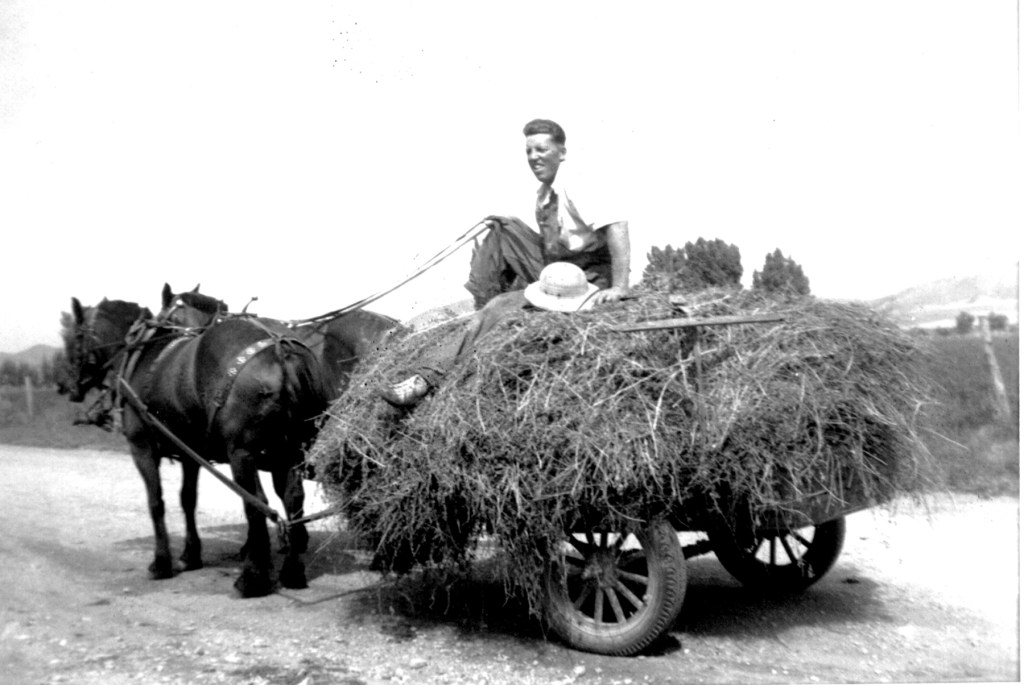
My Father Hauling Hay

It is important to learn about your heritage. Gerrit W. Gong said, “Connecting with our ancestors can change our lives in surprising ways. From their trials and accomplishments, we gain faith and strength. From their love and sacrifices, we learn to forgive and move forward. Our children become resilient. We gain protection and power. Ties with ancestors increase family closeness, gratitude, miracles. Such ties can bring help from the other side.”

A bill was passed by the United States Senate that October would be Family History Month. The Senate of the United States declared: “Interest in our personal family history transcends all cultural and religious affiliations.”

Family History Month is the perfect time to connect with your ancestors. Your children need to be taught about their heritage. FamilySearch is an online genealogical website and you can join for free. There is no fee. It is absolutely free. At FamilySearch, you can add precious photographs to your parents, grandparents, and great grandparent’s person page. Or write a story about them in “Memories.”

Dave Nielsen said, “There’s a reason people around the world seek out genealogy. Psychologists, health professionals, and other experts have explored why for years. Knowing your family’s story can help you feel like you belong to something bigger than yourself. It can also help you have higher self-esteem, more resilience, and less anxiety.”

When I learned about my ancestors, I felt a connection to them and understood my background so much better. It’s interesting to learn what traits we inherited from our ancestors. Thomas S. Monson said, “I admonish all families: search out your heritage. It is important to know those who came before us. We discover something about ourselves when we learn about our ancestors.”

I believe this. When I discovered that my ancestors were from Wales and were musically talented, I was elated because I realized that was where my love for music had come from. I enjoyed sitting at the piano and singing to my heart’s content. My mother never had to tell me to practice. One day my mother told me how my dad’s mother would sing while picking raspberries and that she had a beautiful contralto voice. Mom told me that grandma had sung in the Tabernacle Choir in the early 1900’s. Really? Was that true? I learned something about my Welsh heritage that I didn’t know.

When you learn something new about a grandparent, you find out something about yourself as well. You feel overwhelming joy deep inside yourself.

Dennis Neuenschwander said, “A life that is not documented is a life that, within a generation or two, will largely be lost to memory. What a tragedy this can be in the history of a family. Knowledge of our ancestors shapes us and instills within us values that give direction and meaning to our lives.”

Teach your children about their ancestors so they can be proud of their heritage!

genealogy

Why Is It Important To Remember Our Pioneer Heritage?

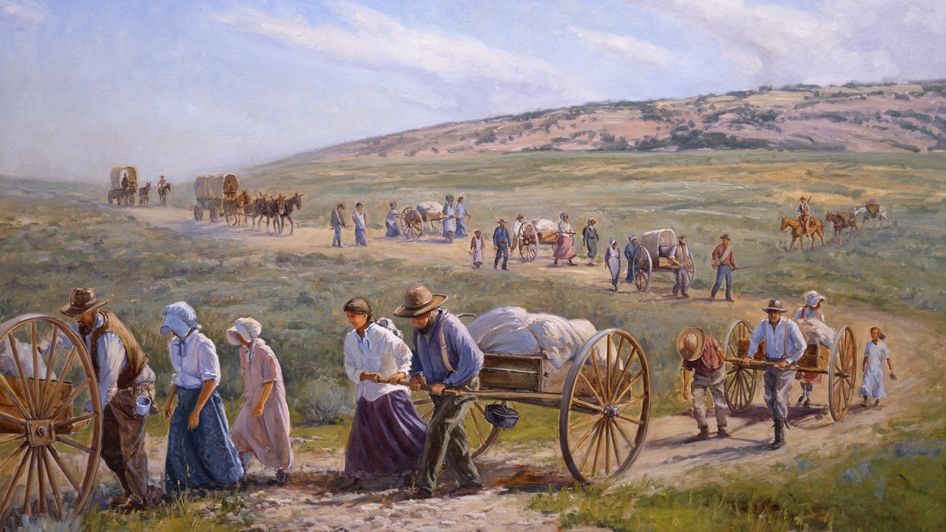
Do you celebrate Pioneer Day or Pioneer History Day in your state? If so, do you know the circumstances of why your ancestors settled in that territory? Was the reason so important to those pioneers that it made a big difference in their lives? My pioneer ancestors trekked across the plains of the United States for a very important reason and it did make a difference.

On the twenty-fourth of July, we celebrate with fireworks, parades, picnics, and concerts. Why is this date so important in Utah? Because this is the day the pioneers arrived in Utah Territory to escape persecution. The members of the Church of Jesus Christ of Latter-day Saints were considered refugees because they were kicked out of their homes in Nauvoo, Illinois just because of their religious beliefs. Mobs got together and burned their homes to the ground and persecuted them. Anyone who resisted were beaten or murdered. So why were they persecuted?

These Christian “Saints,” as they were called, disapproved of slavery and were allowing free blacks to join the Church. The “slave owners” from Missouri and Illinois were upset. Slavery was legal and they were afraid of an uprising or rebellion. They saw the “Saints” and their opinions as a threat to their community and way of life. But how could they stop them? They needed to get rid of Joseph Smith, the founder of the church.

When Joseph Smith decided to run for president of the United States, his enemies were outraged. They needed to stop him. On June 27, 1844, Joseph Smith was martyred at Carthage, Illinois by an armed mob of about 100 men. The murder of Joseph Smith was not spontaneous. It was a deliberate “political assassination” condoned by the citizens of Hancock County in Illinois.

Anyone who got to know Joseph Smith said he was a gentle man. Joseph taught Christian values. He loved our Savior Jesus Christ and had a spiritual nature. He believed in women’s rights, encouraged women to have a say in politics, and was strongly against slavery. Joseph believed in equality and treated everyone with respect, both “black and white, bond and free, male and female… and all are alike unto God.” This was his belief and his followers considered him a prophet of God.

With Joseph Smith out of the way, the persecution grew in Nauvoo, Illinois. Mobs from Missouri and Illinois became more forceful and violent as time went on. That was when the new President of the Church announced that they would be moving out West to the Rocky Mountains.

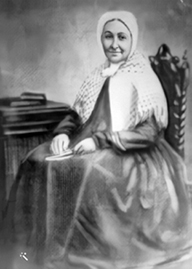
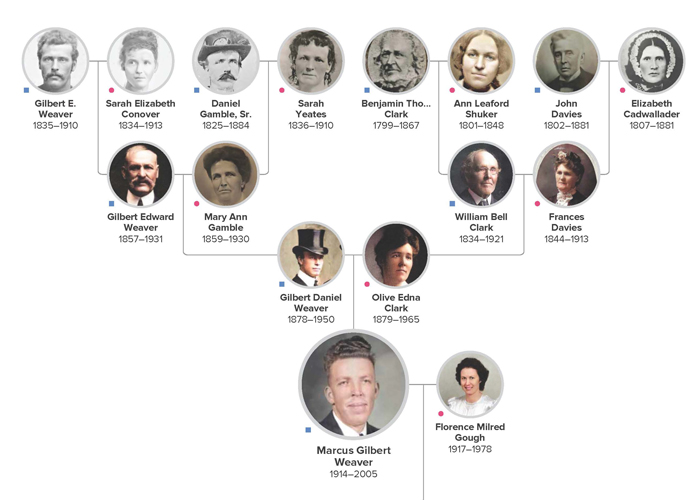
My great, great grandmother did not expect to be the mob’s next victim. Martha Raymer Weaver stood in the doorway of her home, staring at the mob that surrounded her. They were going to force her out of her home. 

The leader was described as a large burly man. Standing before her, he demanded, “Denounce your religion and deny that Joseph Smith is a Prophet of God! If you do, we will not burn down your home.”

Martha had every reason to fear for her life but her strength and faith in Jesus Christ was strong. How could she deny what she believed to be true? She would not deny it. 

Martha faced this wicked man and his mob with dignity. Stomping her foot with defiance, she said, “You may burn it and be damned.” 

Martha’s spunk surprised the mob because she was standing up to them. When the leader realized he could not intimidate her, he said, “I’ll give you twenty minutes to get out.”

Edward Weaver, her husband, had passed away from pneumonia the year before so it was up to her and her seven children to gather their most important items together. She only had one ox and a cow, so the boys yoked them to the wagon. As they drove away, the mob threw a torch to the roof and burned the house to the ground. 

Martha was a brave and courageous woman who stood up for what she believed to be true. So that is why Pioneer Day is so important to the residents of Utah. It is a celebration of freedom where the pioneers could worship God as they pleased. The twenty-fourth of July is a day of celebration.

How about you? Why did your pioneer ancestors move out west and settle down? It is important to learn about your ancestors. We should teach our children to be proud of their heritage.

genealogy, Writing and Arts

WRITING A BIOGRAPHY IN SHORT STORY FORM

When writing a biography, writing in short story form can be easier than you think. Each chapter can be a short story of an amusing experience or a mischievous one. Here are some tips for creating each story. First thing to do is divide it into four sections.

1. The Hook: Introduce your ancestor in chapter 1. Tell something interesting about your ancestor that will grab the interest of your reader. If you’re writing your own autobiography, introduce yourself. I will use my great grandmother Sarah’s biography as an example:

“Sarah Eckersley was a little over a year old when her parents left England on the ship Palmyra. They were six weeks crossing the ocean. On the trip, Sarah was taken ill and her fever was so high that she lost her hearing. When they noticed something was wrong with Sarah, her father shot off a gun and she did not respond. Sarah was deaf.”

This introduction grabs your attention right off because you find out in the first paragraph that she is deaf and you found out why.

2. Develop your Ancestor: Describe your ancestor’s personality. What does he or she look like? List some interesting things about your ancestor. Here are some examples.

  1. Sarah’s mother taught her sign language and she soon was able to communicate with others.
  2. Sarah grew to be a beautiful young woman with black hair and blue eyes, and she was five foot and five inches tall.    
  3. Sarah could tell when the train was coming when it was three miles away because she could feel the vibrations of the train.
  4. Sarah was a very good swimmer and would dive into the water with such poise and grace that passersby would throw coins in the creek to watch her dive after them. 
  5. She enjoyed dancing. Even though she was deaf, Sarah could feel the beat and vibrations of the music and she danced with such grace that most every gentleman wanted to dance with her.

All of these traits tell you what kind of person Sarah was. It grabs the interest of the reader. That is why it is so important to tell what kind of person she was.

3. Construct Events: It sets the stage for what you’re about to tell your reader, leading up to the purpose or plot of the story. Here is an example:

“Sarah had to rely on women’s intuition to raise her family. She knew when her baby was awake and needed her. Her husband never had to tell her. She sensed it. At night, she would wake up even before her baby cried. When the neighbors were visiting, they were amazed when Sarah excused herself to get her baby who had just awakened from a nap.”

At this point, your reader finds out that Sarah listens to inspiration. This is one of her traits and has become part of her because she is deaf.

4. Present the Theme of Your Story: You are now ready to narrate your story. Your character should be faced with a decision to make or a problem to solve. Sarah senses that someone is in her home. What is she going to do about it? She has a “problem to solve.” This is the plot of the story.

After returning to her home one day, Sarah sensed the presence of someone in the house. Acting quickly, she grabbed her broom and began searching. She had a feeling to check her bedroom, but when she entered the room no one was in sight. She carefully stepped to her bed, lifted the ruffle, and looked under. There she found a man crouched and waiting for Sarah, but he was not prepared for a strong and determined woman with a weapon in her hands.

With all the strength she had, Sarah whacked him out from under the bed with her broom. She then pummeled him over the head again and again. Realizing what he was up against, he ran from the house. Chasing after him, she continued beating him as he ran down the street. Sarah had spirit and no doubt this wicked man thought he could take advantage of her, but he found out differently. He did not expect such courage and fled.

By narrating Sarah’s experience, her story comes to life. How would it have sounded with just the facts and no narration?

Here is an example of just the facts: Sarah sensed the presence of someone in the house. She grabbed her broom and began searching. When she looked under her bed, she found a man crouched and waiting for her. Sarah whacked him out from under the bed with her broom and chased him out of the house.

Did you feel part of the story with just the facts? Remember to write your story in narrative style. Add description. Keep it interesting. It is important to narrate your story by putting yourself in your ancestor’s shoes. Make the story come alive. Paint a picture like an artist, making the scenery and characters believable.

Now it’s your turn! Try it. You don’t have to be an author to write a story. Write it in your own words, the way you would talk to a friend when describing an experience you had. Use adjectives to describe your actions and how you felt. That brings the story to life.

genealogy, Writing and Arts

PRESERVING YOUR HERITAGE

Learning about your ancestors can be so much fun. As I learned about mine, it was the beginning of a marvelous journey. Each of us has a story from our ancestors or even our very own story to tell. If these stories are unwritten, how are your children going to know their heritage or family traditions from the past?

It is important to think about our ancestors and how they influenced our lives. We should be proud of them. We are the people we are because of our ancestors.

Thomas S. Monson said, “I admonish all families: search out your heritage. It is important to know those who came before us. We discover something about ourselves when we learn about our ancestors.”

This is true. It’s interesting to learn what traits we inherited from our ancestors. Why do you have an olive complexion? Why are you so tall? Where does your red hair come from? Are you as stubborn as your grandfather? Are you musically inclined? It can be fun to learn about your heritage and all the characteristics you have inherited from them.

James E. Faust said, “Begin to unlock the knowledge of who you really are by learning more about your forebearers… In many ways each of us is the sum total of what our ancestors were. The virtues they had may be our virtues, their strengths our strengths, and in a way their challenges could be our challenges. Some of their traits may be our traits.”

I asked myself. Do I have some traits of my great grandparents? In some way, would my challenges be similar to my ancestor’s challenges? Could his or her strengths be my strengths?

When I found out how courageous my great grandmother was, I became intrigued and wanted to learn more about Frances Davies. I wondered if I could be as brave as she was.

One day a band of thieves came to her home and started gathering her grapes into bags. The grapes were bearing for the first year and it broke her heart because Frances wanted to make grape jelly. She could not allow them to steal her grapes.

As she searched her home for a weapon to defend herself, an inspiration came to her. She quickly donned her husband’s military suit, cap, and long cape. If she looked like a man, she could scare them off. 

Grasping the sword, she bravely marched out of the house onto the porch and into full view of the thieves, brandishing the gleaming weapon in a threatening manner.

“Leave or perish,” she demanded in a loud voice.

Terrified by her appearance, the thieves dropped their sacks of grapes and fled. After they disappeared, she gathered up the grapes and made grape jelly.

One day a neighbor frantically rushed to Frances’ home, begging her to help her husband who had been gored by a bull. His abdomen had been torn open. There were no telephones and only two doctors in town. Not only were they too far away, but there was no one to go for them.

Frances, with courage and a prayer, followed her neighbor home. When she saw the terrible condition he was in, she went to work washing away the blood and gently pushing the intestines back into place the best she could. Then she sewed up his abdomen with a violin gut string that she had soaked in hot water and placed cloths over the wound that were saturated with a liniment she had made herself. It was made of arnica burrs steeped in alcohol.

Each day she washed the wound with carbolic water and applied fresh boiled cloths and liniment. Frances wanted the farmer to have a doctor look him over, but he said he was doing fine and never called one. He lived for more than twenty years.

I asked myself: could my ancestors’ strengths be my strengths? Could their challenges be my challenges? Would I ever have to be as brave as she was?

Gerrit W. Gong said, “Connecting with our ancestors can change our lives in surprising ways. From their trials and accomplishments, we gain faith and strength. From their love and sacrifices, we learn to forgive and move forward.”

Could he be right? Will their sacrifices teach us to forgive those who have hurt us? Will their trials and accomplishments help us to gain faith because of their example? Will their trials and sacrifices strengthen us? I would like to tell you a story about a courageous woman who did not back down and stood up for what she believed.

While living in Illinois in 1844, a mob pounded on the door of Martha’s home. Standing before her, the leader demanded that if she denounced her religion then they would not burn down her home.

Martha had every reason to fear for her life but her strength and faith in Jesus Christ was strong. How could she deny her faith? She would not deny it. Martha faced this large burly man and his mob with dignity. With spunk, she told him that he could burn it to the ground because she would not deny what she believed to be true.

When the leader realized he could not intimidate her, he said, “I’ll give you twenty minutes to pack up and get out.”

With the help of her seven children, Martha gathered all she could into the back of a buckboard. She only had one ox and a cow, so the boys yoked them to the wagon. As they drove away, the mob threw a torch to the roof and burned the house to the ground.

Would I ever have the strength to do what she did? Would I be too afraid to even speak? Would I stand up for my rights as she did? This courageous woman, Martha Raymer Weaver, was my great, great, great grandmother. Her son Gilbert wrote his autobiography and told about this incident.

Did your ancestors struggle at times and have trials to bear? If so, did it make them stronger? Has it made you stronger?

Dennis Neuenschwander said, “A life that is not documented is a life that, within a generation or two, will largely be lost to memory. What a tragedy this can be in the history of a family. Knowledge of our ancestors shapes us and instills within us values that give direction and meaning to our lives.”

Think about who you are. Were your ancestors musically inclined and was that handed down to you? How about mannerisms and the way we express ourselves? Or the way we walk or even talk? These are questions you may have about your heritage.

Russell M. Nelson said, “We have a natural yearning to connect with our ancestors. This desire dwells in our hearts, regardless of age… When our hearts turn to our ancestors, something changes inside us. We feel part of something greater than ourselves.”

I believe this to be true. Something changed inside me. I learned to feel part of something greater than myself. I’ll tell you how this happened. My grandmother died when I was 15 years old. I didn’t know her very well and didn’t know much about her life. One day I sat down and read her autobiography. At that moment, my grandmother’s experiences drew me closer to her and I’m excited to meet her some day in the hereafter.

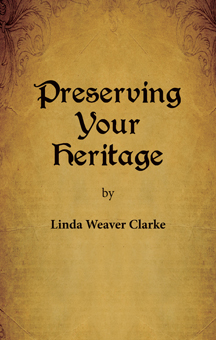
I have recently published a book called: Preserving Your Heritage: Tips For Writing Biographies and Autobiographies—Each of us has a story from our ancestors or our own story to tell. It’s up to us to write these experiences down. In Preserving Your Heritage, you will learn the most important elements of writing. These ideas will help you to write the stories of your heritage in a way that will bring them to life.

genealogy, Writing and Arts

Is it Important to Write Your Parent’s Biography?

Since 2006, I have taught hundreds of classes across the United States, helping those in attendance to write a biography of their father, mother, grandparents or their own autobiography. Many aren’t sure how to go about it so they attend my 2-hour writing class. Some have already written their family stories but wanted to know what more they could add to the story.

While teaching at the Cholla Branch Library in Phoenix, Arizona, a woman raised her hand and said, “I’m a professor at the University and I want you to know…”

I gulped. “Wow!” I interrupted with humor in my voice. “I’m so glad you didn’t tell me that before I began teaching. I would have been very nervous.”

The audience chuckled and the woman continued, “I want you to know that I have attended many writing classes at the university, but I learned more at this two-hour workshop than any class I’ve attended. I want to thank you.”

I was so humbled by what she said. It was something I did not expect, especially from a professor. I asked my husband why she gave me such a wonderful compliment and he said, “I think it’s because you always give examples of what you’re teaching. That really helps.”

One year as I taught my class in Colorado, a gentleman told me that he was a holocaust victim in Poland and his children wanted him to write about his experiences during World War II as a child. He said he wasn’t sure how to begin and what to include. After taking my class, he was so excited to go home and begin writing.

While in California, I met a woman before class began. She said her mother left Germany just before World War II broke out, leaving her parents and nine brothers and sisters behind. Some of them joined the underground to fight against Hitler. As we talked, she said their story was too sad to write about, and she didn’t want to do it.

I knew I had to speak to her about her dilemma but class was about to begin. Hopefully I would be able to answer her question in my lecture. When I finally came to the subject of conflict, I told the audience that this was a very important subject.

I explained, “We must tell about the trials in our ancestors’ lives. If they fought in the underground during World War II, tell about it. These were brave, valiant people who fought for freedom, who fought against tyranny. They fought against the evil powers of Hitler. Your children will be proud of their efforts. Yes, the death of a loved one is sad, but the story must be told.”

The woman smiled as I gazed down at her and she nodded. She had gotten the message and understood what I was saying.

While I was teaching at the Idaho State Historical Society Library in Boise, Idaho, a lady leaned over to my daughter towards the end of class and said: “I felt as if I had handcuffs on my wrists and your mother has just unlocked them.”

As I walk into each library to teach a class, a thrill enters my soul and I know I will be teaching someone who needs my help. Sometimes when I look down into the faces of the people I’m teaching, I’ll see a tear in someone’s eyes as they realize the importance of writing their parent’s stories.

Many times I receive very kind messages from the people who attend my class. Mike Kausch, from St. Louis, Missouri, wrote: “My wife and I received so much information last night at the Kirkwood Library. I believe you have motivated me to finally start writing my family history. We thoroughly enjoyed your presentation.”

At the Stockton County Public Library in California, Mary Jo Gohlke, from Adult Programming, wrote about my class: “I was terribly impressed! She instructs for two hours; the people were genuinely attuned to what she presents. She just impressed the heck out of me. She KNOWS her subject and can present it wonderfully. As I say, she is terrific, thorough, professional, yet strikes just the right chord with her audience.”

Each compliment I received throughout the years really touched my heart. I have had many people ask me to publish a book with my tips on writing a biography or autobiography as a reminder of what they learned. I have recently put one together and named it: Preserving Your Heritage. Below is a description of the book.

Preserving Your Heritage: Tips For Writing Biographies and Autobiographies—Each of us has a story from our ancestors or our own story to tell. It’s up to us to write these experiences down. In Preserving Your Heritage, you will learn the most important elements of writing. These ideas will help you to write the stories of your heritage in a way that will bring them to life. This book is available on Amazon as a paperback and ebook.

Happy Writing, everyone!

genealogy, Writing and Arts

It’s Important to Preserve Our Heritage 

July is pioneer month, a time to think about our ancestors and how they influenced our lives. It’s a time to remember your great grandparents and to be proud of them. We are the people we are because of our ancestors. Thomas S. Monson said, “I admonish all families: search out your heritage. It is important to know those who came before us. We discover something about ourselves when we learn about our ancestors.”

This is true. It’s interesting to learn what traits we inherited from our ancestors. Why do you have an olive complexion? Where does your red hair come from? Why are you so tall? Are you as stubborn as your grandfather? It can be fun to learn about your heritage and all the characteristics you have inherited from them.

James E. Faust said, “Begin to unlock the knowledge of who you really are by learning more about your forebears… In many ways each of us is the sum total of what our ancestors were. The virtues they had may be our virtues, their strengths our strengths, and in a way their challenges could be our challenges. Some of their traits may be our traits.”

I asked myself. Do I have some traits of my great grandparents? In some way, would my challenges be similar to my ancestor’s challenges? Could his or her strengths be my strengths? When I found out how courageous my great, great grandfather was and how he stood up for his beliefs, I became intrigued and wanted to learn more. I wondered if I could be that brave. Here’s an example.

John Davies was from Wales and he worked for a farmer by the name of James Gardner. When Mr. Gardner got word of John’s Baptism, he sent word that he was fired from his job because he did not want a “Mormon” working for him.

One evening John told the missionaries they could hold a meeting in his home to teach the gospel. As soon as Mr. Gardner heard about it, he told John’s daughter to tell her father not to hold another meeting in that house or he would come down in the morning and set fire to their home. The house the Davies we’re renting just happened to belong to this farmer, Mr. Gardner.

Alice ran home and told her father what Mr. Gardner had told her. Turning to the missionary, John said stubbornly, “Elder Williams, go on with the meeting and in the morning I will move my family out of this house.”

After Elder Williams preached a beautiful sermon about our Savior Jesus Christ, he prophesied that Mr. Gardner would not prosper and would die poor. The house was crowded and everyone in attendance heard it. Within two years, Mr. Gardner became very ill and died in poverty.

I asked myself: could my ancestors’ strengths be my strengths? Could their challenges be my challenges? Would I ever have to stand up for my beliefs?

Gerrit W. Gong said, “Connecting with our ancestors can change our lives in surprising ways. From their trials and accomplishments, we gain faith and strength. From their love and sacrifices, we learn to forgive and move forward.”

Could he be right? Will their sacrifices teach us to forgive those who have hurt us? Will their trials and accomplishments help us to gain faith because of their example? Will their trials and sacrifices strengthen us? I would like to tell you a story about a courageous woman who did not back down and stood up for what she believed.

After being forced out of her home in Far West, Missouri because of her religious beliefs, Martha was once again forced out of her home by a mob in Illinois. This time her husband wasn’t beside her because he had passed away from pneumonia. It was just Martha and her seven children. 

The leader of the mob was a large burly man. Standing before Martha, he demanded, “Denounce your religion and deny that Joseph Smith is a Prophet of God! If you do, then you will not be hurt and we will not burn down your home.”

Martha had every reason to fear for her life but her strength and faith in Jesus Christ was strong. How could she deny her testimony? She would not deny it. Martha faced this wicked man and his mob with dignity. Stomping her foot, she told him that he could burn it to the ground because she would not deny what she believed to be true.

Martha’s spunk surprised the mob because she was standing up to them and had no fear in her voice. When the leader realized he could not intimidate her, he said, “I’ll give you twenty minutes to pack up and get out.”

With the help of her seven children, Martha gathered all she could into the back of a buckboard. She only had one ox and a cow, so the boys yoked them to the wagon. As they drove away, the mob threw a torch to the roof and burned the house to the ground.

Would I ever have the strength to do what she did? Would I be too afraid to even speak? Would I stand up for my rights like she did? Looking into the piercing dark eyes of the leader, would my testimony of Jesus Christ be unshaken? This courageous woman, Martha Raymer Weaver, was my great, great, great grandmother.

I work at the Family Search Center as a Service Missionary. Being a missionary there isn’t just about genealogy but learning who our ancestors are and how they lived. At FamilySearch, they say that your grandparents’ lives are “made up of stories that document the joys and tragedies of life. Preserving our stories can bless future generations.” Did your ancestors struggle at times and have trials to bear? If so, did it make them stronger? Has it made you stronger?

Dennis Neuenschwander said, “A life that is not documented is a life that, within a generation or two, will largely be lost to memory. What a tragedy this can be in the history of a family. Knowledge of our ancestors shapes us and instills within us values that give direction and meaning to our lives.”

Think about who you are. Were your ancestors musically inclined and was that handed down to you? How about mannerisms and the way we express ourselves? Or the way we walk or even talk? These are questions you may have about your heritage.

Russell M. Nelson said, “We have a natural yearning to connect with our ancestors. This desire dwells in our hearts, regardless of age… When our hearts turn to our ancestors, something changes inside us. We feel part of something greater than ourselves.”

I believe this to be true. Something changed inside me. I learned to feel part of something greater than myself. I’ll tell you how this happened. My grandmother died when I was 15 years old. I didn’t know her very well and didn’t know much about her life. One day I read her autobiography and learned something about her that drew me to her, and I wanted to learn more about my grandmother. What was in her autobiography that grabbed my interest?

It all started when President Lorenzo Snow received a letter from a Mission President in England, asking for lady missionaries to teach the gospel of Jesus Christ because the English people had the mistaken idea that the Church of Jesus Christ of Latter-day Saints mistreated women and they were being abused. The Mission President said that he needed Utah women to be missionaries and prove them wrong.

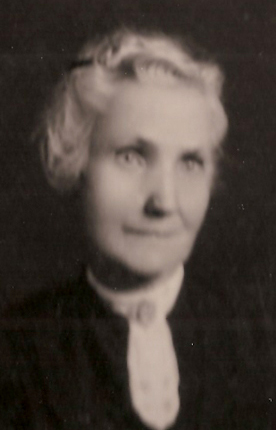
My grandmother, Olive Edna Clark, was one of those first missionaries sent out to teach the gospel of Jesus Christ. At the age of 21, she was the sixth lady missionary sent to England in 1901 for a two-year mission. As I read her mission experiences, I felt a special closeness to my grandmother that I never felt before. Why? I was once a 21-year-old sister missionary. We had something in common!

I learned that they had street meetings where they would sing hymns, teach the gospel, and hand out flyers. That’s something we don’t do today. My grandmother had a beautiful contralto voice and belonged to the well-known Tabernacle Choir before her mission. So you can imagine how her voice easily drew a crowd. She and her companion had a favorite street corner where a half dozen little boys living nearby would watch for them. They learned every word of some of the hymns and would sit on the curb and sing in a loud voice: “igh on the mountaintop.” She thought they were so adorable.

There were times when someone in the group would disagree with their teachings and would try to cause a disturbance. Once someone spit on her companion. Another time someone sicced his dog on them. But the spiritual experiences were those she treasured most. She always listened to the whisperings of the Holy Ghost as she served the Lord.

She wrote: “I knocked on a door. A lady answered and said she knew what I represented and slammed the door. I stood there with a smile on my face and a pleasant gesture. She opened the door the second and third time then asked me in. She said anyone, who can stand there unafraid and with a smile under the circumstances, must have something and know what she’s talking about. I had a nice gospel and social conversation with her and she invited me back again and we became friends.”

My grandmother’s missionary experiences drew me closer to her and I’m excited to meet her in the hereafter. The last time she saw me, I was just a young girl. Does she know how I turned out?

Joseph F. Smith said, “Believe that those who have been faithful, who have gone beyond…can see us better than we can see them; that they know us better than we know them… We live in their presence, they see us, they are solicitous for our welfare, they love us now more than ever… Their love for us and their desire for our well being must be greater than that which we feel for ourselves.”

I hope I have inspired you to sit down and put together your family stories. Don’t put it off. Your children need to be proud of their heritage. I believe our Father in Heaven wants us to learn about our ancestors and understand our heritage. 

genealogy

FamilySearch Helps You Preserve Your Heritage

Is genealogy only about finding your ancestors? No, there’s much more to it than that. It’s about learning who they were and how they lived. At FamilySearch, they say that your grandparents’ lives are “made up of stories that document the joys and tragedies of life. Preserving our stories can bless future generations.”

This is so true. Write something about your grandparent that is endearing or humorous or just worth remembering. It’s something you can share with others. Below is an example of a humorous story I wrote on my father’s Memories page.

When Marcus was thirteen, one day he closed down the school. It wasn’t on purpose, but his friends thought he was a hero. His father had asked him to bury the skunks that he shot so they wouldn’t get into the chicken coop. It wasn’t any big deal because he had been trapping skunks, weasels, and gofers all summer long. But before he buried these skunks, he went to his bedroom and got his glass jar. All summer he had been collecting their scent in a bottle. Before burying the skunks, he drained their scent glands and then screwed on the lid nice and tight.

The following day, he took the “skunk oil” to school with him to show his classmates. Marcus was so excited as he explained what he had done. His friends were listening and a few girls were peeking over his shoulder to see what he had in the bottle. They had never seen “skunk oil” before. With all the excitement and attention he was receiving, he felt the bottle slip from his hands and land on the floor of the schoolroom.

The bottle broke into a million pieces and skunk oil splattered everywhere. It landed on the pant legs of his friends, the skirts of young girls standing nearby, and on his own shoes. As the oil saturated the wooden floor, the girls screamed and the boys moaned as the room filled with the most putrid, foul, disgusting, detestable odor anyone had ever breathed in. The smell was so nauseating and repulsive that it could not be described in words.

The children instantly held their noses with their fingers and turned and ran out the door, stumbling over one another as they ran. Marcus was close behind. And so was the teacher! She excused school for the rest of the day and Marcus did not get into trouble. He figured the children were so excited to get out of school that no one told on him.

To add a story, go to your grandparent’s Memories page.  Click on “Add Memories” and then “Story,” then begin writing. You can add a title to the story and a photo. When you’re done typing, save it. If you want to correct an error in the story later, click the “edit” button. If you would like to copy and paste a story that you have already written, you must enter a space between each paragraph. Otherwise you will have one long paragraph because this program doesn’t recognize “tabs.”

Is that all you can do on Family Search? No, there is more. If you feel writing a story is daunting because you don’t type well or you have arthritis in your hands, I have a fantastic idea. Instead of writing a memory about your father, you can choose to record a memory about him. It is so simple. In his Memories page, click on “Add Memories” and then click “Audio.” Add a title and begin recording by clicking on the red circle with a microphone in the center. When you’re finished, click “Done.” This is a great way of preserving memories of your loved ones.

If your parents are beginning to age and you’re worried about not getting their stories down on paper, just have them sit down and record their own stories on Family Search. Listening to them talk about their experiences can be endearing. Encourage them to get an account and help them get started.

Another way of preserving a long biography that has many pages is by uploading a .pdf document.

What else can you do on Family Search? Adding photos, newspaper articles, documents, and certificates to your grandparent’s page help to tell a story about them. Check with your relatives and find out if they have some old photos and family stories about your grandparents. A distant relative may have something you didn’t know about.

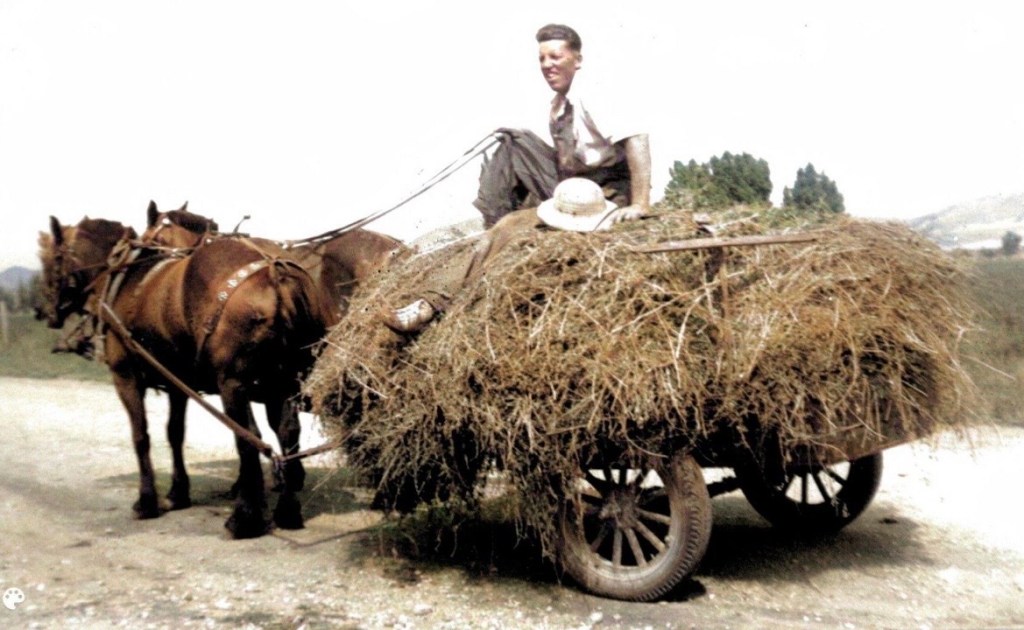
Below is a photo I found of my father sitting on a hay wagon. I love this photo. It tells a story about how they farmed way back in the early 1900s.

It is so simple to add photos and documents to your grandparent’s page. This program supports .jpg, .tif, and png. This can be fun to add memory after memory to your ancestor’s Memories page.

How about the privacy of a living person? If your parents are still alive, only you can see their page in FamilySearch. Once your parents have passed on, any photos, documents, and stories that were attached to their page will be visible to all your relatives. The same goes for you, as well. If you choose to attach a bunch of awesome photos and stories about yourself to your page, they won’t be visible until you pass on. This is for your own privacy.

Is that all you can do on Family Search? No, there is still more. If you have a recording of your relative singing or just talking about a childhood experience, you can upload it to his or her page. Just click on “Add Memories,” “file,” and “Your Device.” At this point, you may add anything that is .mp3, .m4a, and .wav up to 15 MB. I was excited about this feature because I have a CD with me singing at a recording studio. I added each song to my page. But… no one can see my page at this point until I pass on.

If you’re interested in joining Family Search, anyone over 13 years of age can create an account. Here are the steps to follow. It is important to have your mobile phone with you to activate your account.

1. Go to FamilySearch.org and click Create Account.​​

2. Enter the required information along with a username and password.

3. Click on “text” or “email” for a recovery option in case you forget your username or password. If your country is not in the location list, you must use an email address for recovery.

4. To agree to the terms, check the box andclick “Done.”

5. Look for a message in your email or a text message on your phone to activate your account.

By the way, there is also a Family Search mobile app that you can upload to your phone. Just sign in with your account username and password. Once you sign in, you won’t have to sign in again unless you change your password. Have fun! Enjoy getting to know your ancestors.

Click on the link below and it will take you to FamilySearch.

To learn how to start your family tree, add ancestors, add photos, and add stories about each ancestor, watch this 14-minute video.

genealogy

Discovering Your Heritage

Have you ever wondered who your ancestors were? Where did they come from originally? Did they struggle at times and have trials to bear? If so, did it make them stronger? Were they musically inclined and was that handed down to you? How about mannerisms and the way we express ourselves? These are questions that many have about their ancestry. As you discover your ancestors, remember to be proud of your heritage.

I work at a genealogy center called Family Search, a non-profit organization, where I help people find their ancestors. It’s free to the public and their services are absolutely free. People from all different countries, cultures, and religions walk into our Center for help. It is so fun to learn about another person’s heritage as I help them. But you don’t have to go to a Family Search Center to find your ancestors. It’s online, too. Like I said, it’s absolutely free because it’s church-owned.

How old is Family Search? It was created in 1894 called The Genealogical Society of Utah. The Church of Jesus Christ of Latter Day Saints wanted people to understand their heritage so they provided this means to find them. By 1924, they were able to help people in several different languages. By 1938, microfilm was used to find your ancestors. By 1964, family history centers began opening up in city after city.

Finally Family Search created its own website in 1999 and it became the most popular family history website online, receiving 7 million hits per day. Three years later, in 2002, records such as birth, marriage, death, census, and obituaries were uploaded to the site. By 2013, 1 billion records were indexed and uploaded to Family Search. By 2018, they had uploaded 2 billion records.

Since 2020, the Family Search website gets an average of 400,000 visitors per day and is 100 percent digital. If you prefer having someone help you one-on-one, Family Search Centers are in 5,000 cities worldwide. Check your area and see where the closest one is.

Each month millions of new records are added from the early 1500s to the early 1900s. Family Search reported: “FamilySearch expanded its free online archives in February 2023 with over 309 million new-name searchable genealogy records from 56 countries.”

Recently over a million records were just added for Austria, France, Germany, Hungary, Ireland, the United Kingdom, Poland, Russia, Ukraine, the Ivory Coast, and South Africa. On the American continent, newly added records were added for Brazil, Colombia, Ecuador, Mexico, Peru, and the United States.

If you’re interested in learning more about your ancestors, anyone over 13 years of age can create an account. How do you create an account? Here are the steps to follow. It is important to have your mobile phone with you to activate your account.

1. Go to FamilySearch.org and click Create Account.​​

2. Enter the required information along with a username and password.

3. Click on “text” or “email” for a recovery option in case you forget your username or password. If your country is not in the location list, you must use an email address for recovery.

4. To agree to the terms, check the box andclick “Done.”

5. Look for a message in your email or a text message on your phone to activate your account.

By the way, there is also a Family Search mobile app that you can upload to your phone. Just sign in with your account username and password. Once you sign in, you won’t have to sign in again unless you change your password.

To help you learn how to start your family tree on FamilySearch, add ancestors, add sources such as birth and marriage certificates, add photos, and add stories about each ancestor, watch this 14-minute video. Have fun! Enjoy getting to know your ancestors.

Click on the link below and it will take you to FamilySearch.

genealogy, Writing and Arts

Love and Courtship

It is so interesting to learn how people fall in love. Everyone’s courtship is so different. Some people marry their childhood sweetheart. Others meet over the Internet. And there are those who go on a blind date, not knowing what to expect. Some say it was love at first sight. Another admits that she didn’t much care for her future husband at first. After getting to know one another better, all that changed.

In my case, my husband and I met at college but it was nothing more than friendship. He dated my girlfriend and we ran around with the same group of friends. The following year I moved to another college and then served the Lord for 18 months in Colorado and Texas. After being away for three years, I moved back home and we renewed our friendship.

When my mother asked me if he was the right one, I quickly answered, “Of course not. We’re just friends, Mom. Nothing more. Besides, we don’t have that much in common.”

Little did I know that was going to change! As we got to know one another, his humor and charm pulled me into his world. Gradually my feelings of friendship changed to romance, something I did not expect.

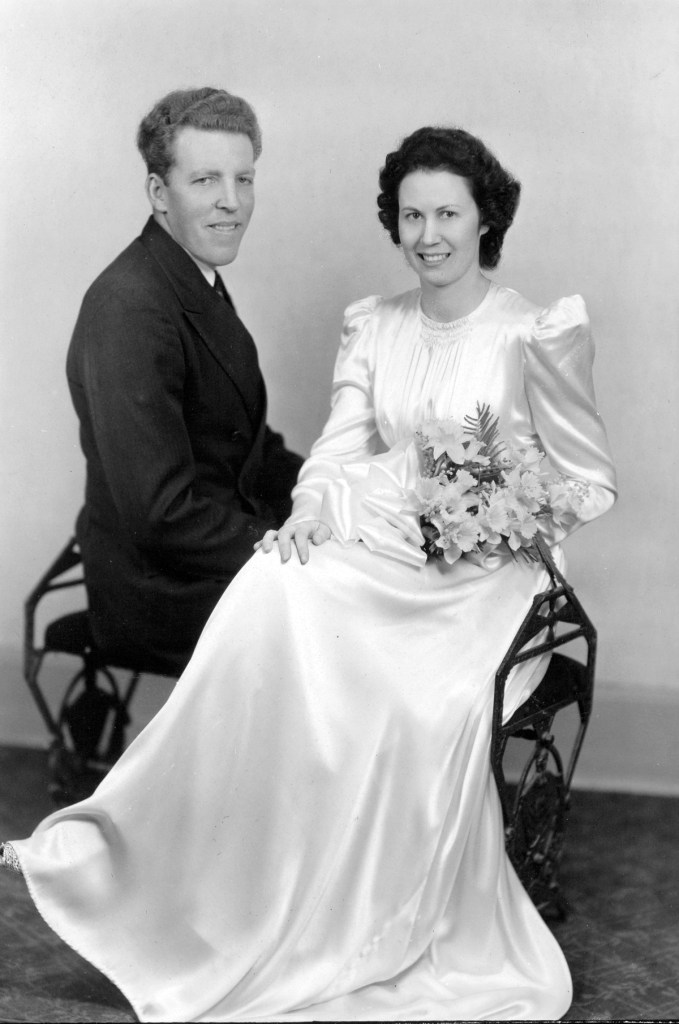
How did you meet your spouse? Was it a long-term relationship or was it love at first sight? Did a friend introduce you and tell you that he or she was perfect for you? That was the case with my mother. Her friend introduced her to my father but it was not the conventional way. It was through letters.

Doris accused Mom of being too picky. No man seemed to match up to the standards she wanted. After dating for a month or two, she would stop dating the young man because he just wasn’t the right one. One fellow actually proposed to her but she kindly turned him down.

One day Doris asked her what she was looking for so she could help her find the right man. Mom replied, “I will only marry a righteous man, a man who is musically talented, and a red head.” Mom’s reply made her friend laugh. Was she trying to make her job of searching for the “right one” harder? Apparently she was partial to redheads.

At that time, Doris was teaching school in southern Idaho, a day’s journey by car. After much thought, she decided that the custodian of the school might be the right catch for her friend. Doris had gotten to know Marcus quite well and liked him. He was a good man and owned his own farm. He played the guitar and had a beautiful deep bass voice. As for the color of his hair, it was auburn. That was close enough! To Doris, he was the perfect match for her friend. The year was 1941 and there was no such thing as the Internet back then.

As they wrote to one another, Mom learned more about him than a person would by dating because it was easier to express oneself and talk about one’s innermost feelings about life. It was a different way of communicating than she was used to. They never sent a photo of themselves to one another, but that didn’t make a difference. What was said in their letters was what really mattered.

With each letter he wrote, she found herself entranced by his beautiful words. Without a doubt she was falling for this mysterious man, someone she had never met. Finally it was agreed upon that they meet, so Mom hopped on the train and headed to southern Idaho. Doris picked her up at the train station and that night they went to the old Persiana Dance Hall so she could meet the man she had been writing to for about a year.

When they arrived at the Dance Hall, Mom waited anxiously with butterflies in her stomach and great anticipation. What did he look like? Would he be as romantic in person as his letters? Her heart would not slow down as she waited for his arrival.

When Marcus finally walked through the doors of the building, their eyes met. She wrote: “I didn’t know what he looked like, but when he came across the dance floor, my heart jumped and a warm glow filled my soul. He introduced himself and I knew he was the right one.”

As for my father, he stood gazing at her, feeling nervous and excited. He had never expected her to look so lovely. Dad expressed how he felt about Mom as he wrote: “I dreamed I met a girl Saturday night, a perfect girl whom I had been thinking of, who far surpassed my imagination. (In plain words, she was just much better than I thought she could be.) As we swept over the floor to the rhythm of the music I was in love with her from that moment.”

Mom was very picky and didn’t give many men a chance. But she finally found the man she was searching for… through letters.

After learning about their courtship, I decided to write a story about a couple who met through letters that was just as romantic, giving her the same feelings that my mother once had while searching for the right man. Although in my story, the young man just happens to live in the same town.

In Edith and the Mysterious Stranger, Edith has wonderful qualities but never gives a man a second chance because her expectations are so high. However, all that changes when a mysterious stranger starts writing to her. For the first time, she gets to know a man’s inner soul before making any harsh judgments. Whoever he is, this man is a mystery and the best thing that has ever happened to her. The question that puzzles her is whether or not he is as wonderful in person as he is in his letters.

To give my story authenticity, I decided to borrow some of my father’s letters and use them in my story. They were so romantic that I just couldn’t help it. I only used just a few of them… my favorites. Will writing letters to Edith work? Read the book and find out.

Watch the Book Trailer.

This book can be purchased at Amazon and Audible audiobooks.

Audible: https://www.audible.com/pd/Edith-and-the-Mysterious-Stranger-Audiobook/B07BN2MJT3

genealogy, Writing and Arts

Can Our Ancestors Teach Us To Appreciate Life?

We all have trials in life and we sometimes wonder if we can ever get through them. Then we get an awakening, something that helps us to appreciate the trials we do have. If given a choice, we would probably choose the problems we have rather than someone else’s hardships. Why is this?

One day when I was feeling blue, my mother took me aside and told me about a young woman who made the most of her life. Most everyone loved her because of her good nature. I wondered why my mother thought so highly of her and I soon found out.

With great affection in her voice, Mother told me that her grandmother, Sarah Eckersley Robinson, was a little over a year old when her parents left England on the ship Palmyra. On the trip, Sarah became ill. Her fever skyrocketed and her parents were worried they were going to lose their little daughter. It was a miracle that she made it through the illness.

When her mother noticed something was wrong, her father shot off a gun into the air and she did not respond. Her fever was so high that she had lost her hearing. Sarah was deaf.

As Sarah grew, her mother taught her sign language and she soon was able to communicate with others. I didn’t realize they taught sign language at such an early time in history. In fact, I was surprised to learn that the first American School for the Deaf was founded in Hartford, Connecticut in 1817. Soon more and more schools began teaching the deaf, giving them an education.

I asked my mother how Sarah communicated with others because not everyone knows sign language. What kind of education did she get? Did Sarah find lip reading easy or difficult?

According to a friend who lost her hearing, she said that sometimes she would misunderstand what someone said because some people form their words differently. Beards are especially a problem. If they are not well trimmed, it isn’t as easy to see their lips as they form their words.

My mother told me that her grandmother was able to live a fairly normal life. She was a good swimmer and would dive with such poise and grace that passersby would toss coins in the water, just to watch her dive after them.

Sarah Eckersley Robinson

Sarah grew to be a beautiful young woman with black hair and blue eyes. She loved going to parties. The boys enjoyed dancing with her because she danced so gracefully. She would glide across the floor with the music, not missing a step. Even though she was considered deaf, she may have heard the low deep tones of the band or feel the beat and vibrations of the music. Either way, she was a graceful dancer.

Sarah was not a timid young lady. She had spunk and courage. She always listened to the spirit of the Lord and followed the promptings given her. After returning home one day, Sarah sensed the presence of someone in the house. Acting quickly, she grabbed her broom and began searching. She had a feeling to check her bedroom, but when she entered the room no one was in sight. She carefully stepped to her bed, lifted the ruffle, and looked under. There she found a man crouched and waiting for Sarah, but he was not prepared for a strong and determined woman with a weapon in her hands.

With all the strength she had, Sarah whacked him out from under the bed with her broom. She then pummeled him over the head again and again. Realizing what he was up against, he ran from the house. Chasing after him, she continued beating him as he ran down the street. Sarah had spirit and no doubt this wicked man thought he could take advantage of her, but he found out differently. He did not expect such courage and fled.

Sarah’s faith in God was amazing. Can our ancestors teach us to appreciate life? I believe they can with their examples and trust in God.

Dieter F. Uchtdorf said, “It is often in the trial of adversity that we learn those most critical lessons that form our character and shape our destiny.”

Dallin H. Oaks said, “Adversities are temporary. What is permanent is what we become by the way we react to them.”

My great grandmother’s faith and courage touched my heart, and she was the inspiration for my historical romance: Sarah’s Special Gift. In this novel, Sarah is a beautiful and successful dance teacher. But she is not like other young ladies. She is deaf, but this does not stop her from living life to its fullest. While visiting the Roberts family, David finds himself entranced with this very special lady and ends up defending her honor several times. He finds that Sarah has gone through many trials as she teaches him how to love life.

Allison King, from Allison’s Attic, wrote: “The romantic friction between David and Sarah is central to a story that will have you cheering for them to get together! This is a heart-warming story of finding that right person to live the rest of your life with. It teaches us that people with disabilities are just like any other person who has dreams for their life. So, if you want to laugh, learn and live in the life of some wonderful characters… read this book and enjoy the journey!”

Watch the Book Trailer on Vimeo. 

This book can be purchased as an eBook, paperback, or as an audiobook at Amazon and Audible.

genealogy, Writing and Arts

Have You Made A New Year’s Resolution?

A New Year’s resolution can inspire you to do something you have been putting off. Have you ever considered writing your parent’s and grandparent’s biography? How about writing your own autobiography? Make it your New Year’s Resolution.

Why should you write your family history? Writing your family stories can help you appreciate your heritage. Each of us has a story from our ancestors or even our own story to tell. If these stories are unwritten, how are your children going to know their heritage or family traditions? Will these stories and traditions be lost to your children because no one put them down on paper? It’s up to you to write down these experiences so your children can be proud of their heritage.

This will be the beginning of a marvelous journey for you. You will learn things about them that you didn’t even know.

Whether you’re writing about a loved one or your own story, you might feel that it is overwhelming and aren’t sure how to begin. If you have an inspiring story to tell or intriguing incident to relate, perhaps writing each experience as a short story would be easier for you, rather than writing the stories in chronological order. Each chapter could be a short story.

How do you begin? How do you write your story to make it interesting? First thing to do is introduce your ancestor. You can begin with a humorous incident for your first chapter. That will easily grab the attention of your reader.

As you tell a hilarious incident, don’t forget to describe your relative. What does he or she look like? This way the reader can picture his grandfather in his mind.

How do you make the story interesting? The best way is putting yourself in their shoes. Adding feeling to your story is very important. If you don’t weep while telling a sad story, then write it again. If you don’t laugh during a funny incident, then rewrite it. You need to touch your own heart first before you’ll touch the hearts of your readers. How do you go about this? You must describe how your ancestor must have felt. It’s important to add feelings of joy, enthusiasm, fear, laughter, or even frustration to your story. If you’re writing your own story, tell how you felt as you tell about an incident that happened to you.

If you were scared, did your knees shake? Did your heart beat rapidly? Did you tremble? When my grandmother wrote about some experiences she had in her journal, I was impressed with how she described her emotions. This is what she wrote:

“I took to the center of the road as it was darker on the walks and I didn’t like to get too near those weird looking factory buildings and alleys on both sides of the silent streets. Presently I heard footsteps. I saw a man following me. As I hurried, he also did. My tongue became dry and fear seized me. I prayed as I ran. I not only ran but I flew. How I crossed that tiny footbridge, I never knew! But I couldn’t feel the touch of the ground under my feet as I sped onward. With my Bible clutched tightly under my arm, I had left the man, downs, and everything behind, and was soon on the lighted highway and home.”

That was a great description of fear. If you have written your own autobiography or your grandparent’s account of a fearful experience, read it again and notice if you added “emotion” to your story. This makes it hard for the reader to put down the book.

If you were frustrated about something, did your face turn red? Did you stomp your foot? Did you throw your hands in the air? How about feelings of love? Your children would absolutely love to find out how you felt about your spouse when you first met. When I asked my mother what it was like when she first met my father, this is what she told me. “When our eyes met, my heart leapt within me and a warm glow filled my soul.” I was so impressed with her description.

When I read my father’s account, this was what he wrote: “All I remember is a wonderful perfect dream that goes through my mind like a marathon night and day. I dreamed I met a girl Saturday night, a perfect girl whom I had been thinking of, who far surpassed my imagination. As we swept over the floor to the rhythm of the music I was in love with her from that moment.”

This description touched my heart. How would your children respond when they read your feelings of love toward your spouse? This is something to think about.

Remember! Emotions, feelings, moods, and describing how you felt are very important. It brings a story to life. It helps the reader to become part of the story and it will be hard to put the book down. What is the secret of grabbing your reader’s attention? You must put yourself in their shoes.

Don’t forget to add photos! They also tell a story. Remember to scan your pictures at 300 dpi for the best resolution.

There are many places to publish your book but my favorite is Kindle Direct Publishing, which is an Amazon company. You don’t have to pay anything upfront. It is absolutely free and it’s posted on Amazon. When you’re ready to buy a book, you only pay for the printing cost. For a 104-page black and white paperback, I only pay $2.15 per copy. For a 93-page color paperback, I pay $4.20 a copy. Amazon charges shipping but it’s charged by the weight of the items.

Begin today. Start writing your parent’s biography, your grandparent’s biography, and your own autobiography. Trust me. It’ll be fun.

genealogy, Writing and Arts

Courageous Women Throughout History

The women of the past were brave and spirited ladies who knew what they wanted in life and wanted to make a difference. In the late 1700s, Abigail Adams, the wife of John Adams, was the first woman to stand up for women’s rights but America wasn’t ready for equality at that time.

Elizabeth Stanton

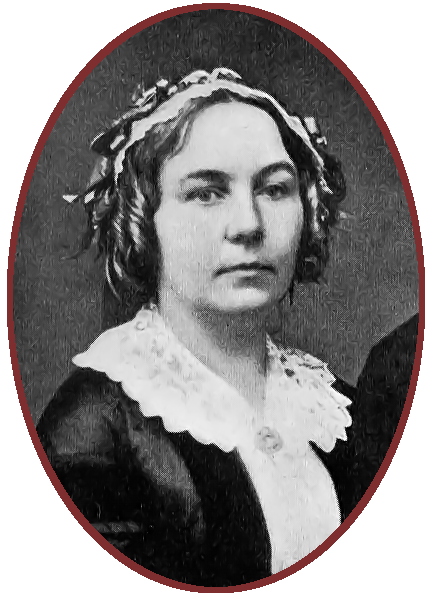
There were many who spoke out on women’s rights. Elizabeth Stanton was one of them. She stood up and said that women should have the right to vote and receive equal education. She also was an abolitionist and fought adamantly against slavery, prejudice, and inequality but it was not readily accepted.

When she gave lectures on the subject, it was frowned upon. A pastoral letter from a minister in Massachusetts said a woman who speaks publicly is “unwomanly and unchristian.” The pastor also mentioned that it would “threaten the female character with widespread and permanent injury.” Was this how the men really felt back then? Why were women being held back? Even though it was not proper, women still gave their opinions.

Susan B. Anthony was another. When she defied the laws and voted illegally on November 5, 1872 in a presidential election, she was arrested and fined $100. But she refused to pay it. She said, “Resistance to tyranny is obedience to God.”

These courageous women made a difference in history. They fought for equal education and wanted the right to vote. Did you know the first four states to give women the right to vote were Wyoming, Colorado, Utah, and Idaho? It did not take long until women began running for office in each of these states.

Photo was colorized

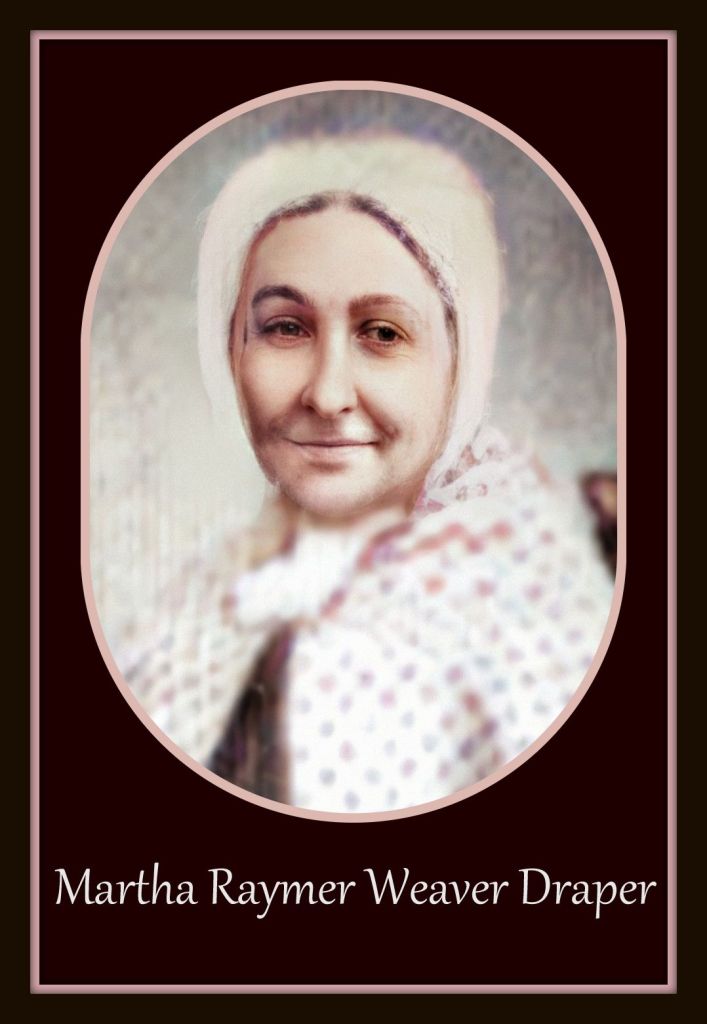
Do you have some courageous ancestors that were an influence on you? I had a great grandmother who stood up for her rights and would not allow anyone to intimidate her. She was told by a group of men that if she denounced her religion then they would not burn down her home. The leader of the mob was a large burly man and she had every right to be frightened. But Martha would not give in to fear. She was a devout Christian and would not deny her Faith. With strength and courage, she stomped her foot and said: “You may burn it and be damned.”

Frances Davies

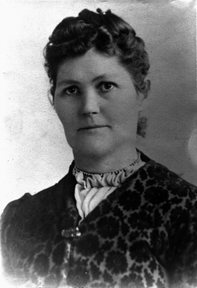
I had another great grandmother who was an influence on my life. When she saw some thieves stealing her grapes, she knew they would not be afraid of her if she tried to chase them off. An idea came to her. Frances put on her husband’s cavalry uniform, tucked her hair inside his hat, and grasped his sword from its scabbard. Bravely marching outside onto the porch, she brandished the weapon in a threatening manner and demanded in a loud voice “Leave or perish!” I’m sure she smiled inside when she saw them take off like scared rabbits.

It touched my heart when I read about another great grandmother’s experience, which was written by her daughter. Her courage and difficulties touched my heart.

Hannah and her husband came here to America in the mid-1800s for a better life. On the ship from England, Hannah’s one-year-old daughter became very ill, which resulted in deafness. One year after arriving in America, Hannah gave birth to a baby boy but she was not meant to have him long. He died six weeks later. A year later, the sheriff came to her door and announced that her husband had been murdered on the streets of St. Louis, Missouri. Realizing she had to make a living for her children, Hannah took a job as a maid at the largest hotel in St. Louis, hoping to earn enough money to move on.

What a courageous woman! Would I have been that brave if I were Hannah? Would I have turned around and headed back to my family in England? Her family volunteered to pay her passage if she returned. But she chose to stay instead.

“No matter our circumstances, no matter our challenges or trials, there is something in each day to embrace and cherish. There is something in each day that can bring gratitude and joy if only we will see and appreciate it.” ~ Dieter F. Uchtdorf

This was Hannah’s attitude as she tried to search for the “light at the end of the tunnel.” How many times do we search for that light, wondering where it is and hoping that our trials will soon end? Is God watching over us? Is He there when we need some comfort? In our darkest moment, does He know how we feel? I believe He does.

Five years later, Hannah earned enough money to board a riverboat and head northward, far away from St. Louis. That was when she met a wonderful man who fell in love with her. My great grandmothers were an example to me. If I were in their shoes, I wonder if I would have had that much courage. After reading their biographies, I took their stories and created a series of novellas called Women of Courage. Hannah was the inspiration for the first novella. Using her experiences, I created a historical romance called The Light at the End of the Tunnel.

In The Light at the End of the Tunnel, Hannah is a young single mother who has had some hardships since arriving in America. But the trials in her life only make her stronger. Wanting to be independent, she opens a hot chocolate shop. At first, it’s a struggle. But she will not give up.

In A Lady of Refinement, Serenity is an educated young woman from Wales. After arriving in America, she decides to teach adults how to read and write. She is determined to help the citizens learn the enjoyment of reading. One of her favorite books is Ivanhoe by Sir Walter Scott. No one seems to measure up to this valiant knight until Jonathan comes along.

In A Mississippi Sunset, Laura gives lectures regularly, encouraging women to fight for their beliefs and be heard. Equality is her message. But she soon finds out that women who speak publicly are looked down upon and criticized, saying it is unwomanly and unchristian to speak publicly. But she has faith in God and knows He will help her in the cause for justice.

https://vimeo.com/721762655

Women of Courage Series

The Light at the end of the Tunnel: When Thomas finds out that Hannah’s shop is struggling, he comes to the rescue with a clever plan. Will she agree to such an unconventional idea? Can he convince her to find room in her heart for one more person?

Listen to this audio book at Audible: https://www.audible.com/pd/The-Light-at-the-End-of-the-Tunnel-Audiobook/B0B4F65DGY or buy the book from Amazon below.

A Lady of Refinement: When Jonathan meets Serenity, an educated and courageous woman from Wales, he becomes intrigued with her and wonders how he can win her heart. Her brother gives him some advice, but Jonathan begins to question his wisdom. Should he trust his friend or is he leading him astray?

A Mississippi Sunset: When Deputy Davies meets Laura, he is intrigued with her independent nature. He admires her spunk and wonders if such a woman would be interested in a small town deputy like himself.

genealogy, Writing and Arts

Tips for Writing a Biography

Part 4

Editing & Publishing Your Biography

First thing to do before publishing your book is to edit your story a few times to make sure there are no mistakes or spelling errors. As you edit your story, watch for repetition.

  1. Delete clarifying details. You want to keep the reader’s interest. The reader is smart, so you don’t need to re-emphasize a situation.
  2. Learn to recognize repetition. Most readers will skip over a paragraph that is repeated. Even though it’s said differently, it’s still repetitive.

Next on the list! Don’t forget the Title Page and don’t forget the Copyright Page! Some people are worried about copyrights. The United States backs up the “Berne Convention for the Protection of Literary and Artistic Works,” which means your work is protected from the moment you create it. You own the copyright to any work you create when you put it in a readable form. By placing the copyright symbol © on your work, you are saying that you own the rights.

Give a date of the original publication with your name, such as: Copyright © YEAR, Your Name. All rights reserved. No part of this book may be reproduced or transmitted in any form without permission in writing from the author.

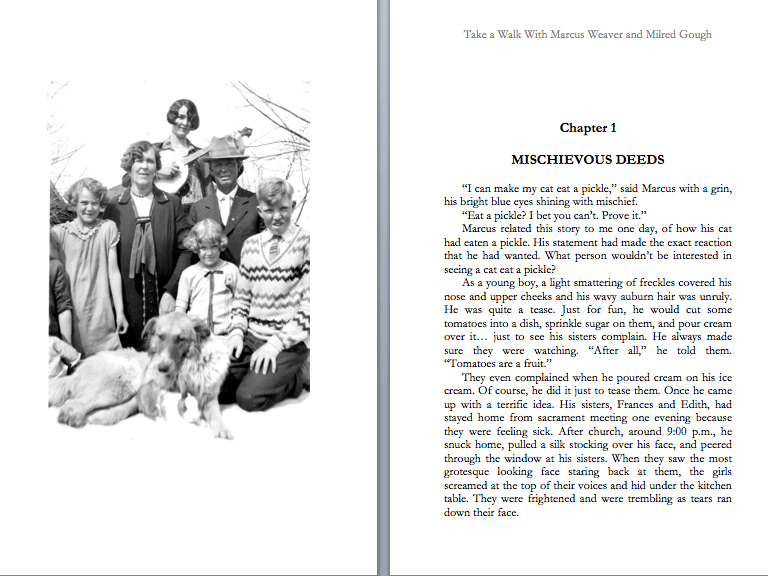
You want your book to look professional. Check every page and make sure the “chapter page,” which says Chapter One, etc., is on the right side. The right side is always the odd numbered pages. If you need to, you can have a blank page or a photo on the left side.

Example

Add photos! They help in telling a story. Remember to scan your pictures at 300 dpi for the best resolution. You don’t need to scan it any higher. When inserting your photo, I wouldn’t choose “wrap around” because the photo tends to move about. I would click “insert” at the top of the Word Document and insert it either above or below your paragraph. Or you can put them on the left side of the page, separate from your writing, like the example above.

There are many places to publish your book but my favorite is KDP. Kindle Direct Publishing is an “Independent Publisher” and the quality is excellent. You don’t have to pay anything upfront or buy a certain amount of books. It is absolutely free. All you have to do is upload your manuscript in the correct size you prefer. If you need any help with a book cover, they have a place on the KDP website where you can create your own book cover.

KDP will make your book available on Amazon and at Barnes and Nobles. Also, you get to set the retail price. Remember! You only have to pay the printing cost when ordering your books. Not the retail price. You can buy them on the KDP website where you uploaded your book. You are not limited to how many books you can buy. You can buy as many as you want at any time and as many times as you like.

Here are some examples. For a 5.25 X 8 inch black and white paperback, 241 pages, I pay $3.79. For an 8X10 paperback in color, 72 pages, I pay $3.44. The quality is excellent. KDP allows you to publish your book as a paperback, an eBook, and as a hard copy.

If you have any questions, let me know your concerns and I’ll try to answer them.

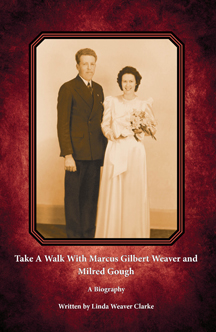
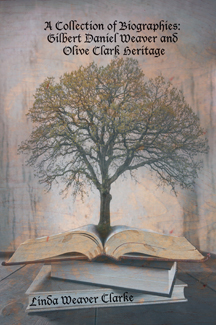
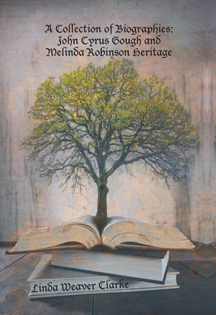
Here are some examples of book covers that my husband created for the biographies that I published.

genealogy, Writing and Arts

Tips For Writing a Biography

Part 3

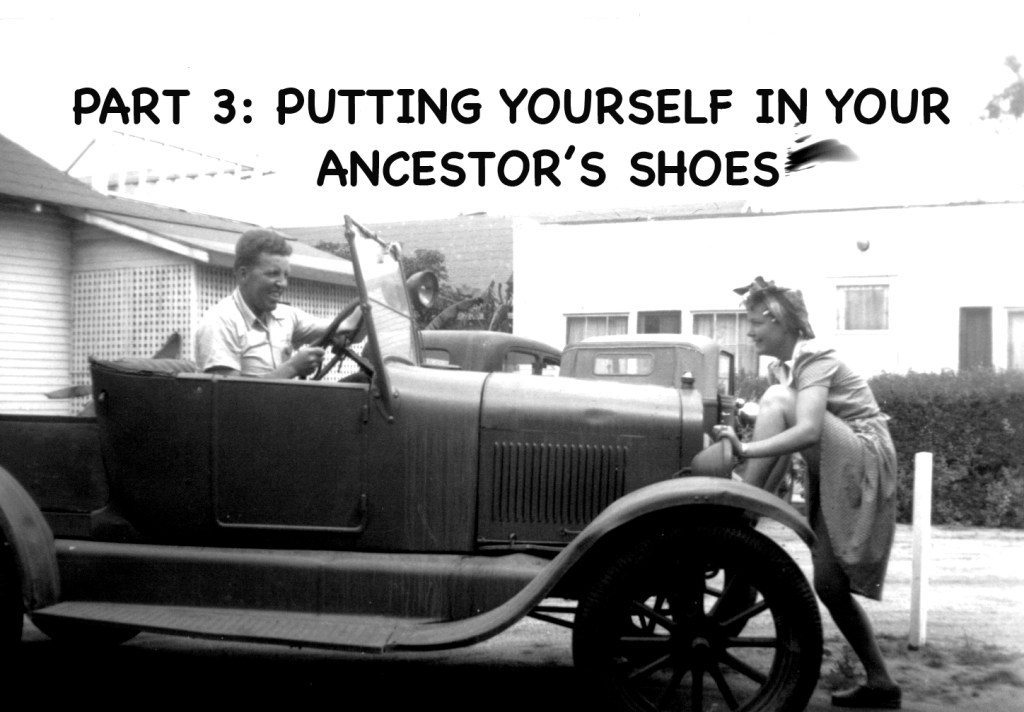
Putting Yourself in Your Ancestor’s Shoes

Adding emotion to your story is very important. If you don’t weep while telling a tragic story, then begin again. If you don’t laugh during a hilarious incident, then write it again. You need to touch the hearts of your readers. How do you do that? By adding emotion and describing how you or your ancestors must have felt. It’s important to add feelings of fear, frustration, anger, etc. If you’re writing your own story, tell how you felt.

Fear: My knees shook, my heart beat rapidly, I trembled.

Anger: My face turned red, I clenched my jaw, I stomped my foot.

Frustration: I threw my hands in the air, I shook my head with frustration and said…

Love: Your children would love to find out how you felt about their father when you first met.

 Here is an example of showing fear in my father’s biography. “Once Marcus came up with a terrific idea. His sisters, Frances and Edith, stayed home from church one evening because they were feeling sick. Around 9:00 pm, he snuck home, pulled a silk stocking over his face, and peered through the window at his sisters. When they saw the most grotesque looking face staring back at them, the girls screamed at the top of their voices and hid under the kitchen table. They were frightened and were trembling as tears ran down their face. When Marcus heard them, he opened the door and walked into the house with the stocking still over his head and gently said, “Don’t cry little girls. I won’t hurt you.” When they recognized his voice, they became angry and told their parents what he had done. Needless to say, he got into trouble over this little incident.”

When I asked my aunt about this experience, she said it was the most “grotesque looking face” she had ever seen, so I used her very words. She said they were scared and began crying. Instead of saying they were scared, I wrote: They were frightened and were trembling as tears ran down their face. By describing fear, it brings the reader into the story and they understand how the girls felt. You must put yourself in your ancestor’s shoes.

When my grandmother wrote about some experiences she had in her journal, I was impressed with how she described fear. This is what she wrote:

“I knocked at the door of a wealthy home. The man came out, took my tract, tore it into bits and called his large dog out of the house. I left with that dog pursuing me. With my hair rising and a terrible fear attacking me, I silently prayed and something told me to whirl about and thrust my open umbrella at him. I did so and that huge dog retreated. Then I told his inhuman master a few things.”

It was easy to feel what my grandmother felt when I read: “with my hair rising and a terrible fear attacking me.” That was a perfect description. Here’s another example from her journal.

“I took to the center of the road as it was darker on the walks and I didn’t like to get too near those weird looking factory buildings and alleys on both sides of the silent streets. Presently I heard footsteps. I saw a man following me. As I hurried, he also did. My tongue became dry and fear seized me. I prayed as I ran. I not only ran but I flew. How I crossed that tiny footbridge, I never knew! But I couldn’t feel the touch of the ground under my feet as I sped onward. With my Bible clutched tightly under my arm, I had left the man, downs, and everything behind, and was soon on the lighted highway and home.”

That was a great description of fear. If you have written your own autobiography or an ancestor’s account of a fearful experience, read it again and notice if you added “emotion” to your story. It will be hard for the reader to put down the book.

How would you describe feelings of love? My parents had been writing to one another for about a year before they met one another. When I asked my mother what it was like when they first met, this is what she told me. “When our eyes met, my heart leapt within me and a warm glow filled my soul, telling me that he was the man I was going to marry.”

I am so grateful that she told me how she felt. It was the perfect description. But how did my father feel? This is my father’s account: “All I remember is a wonderful perfect dream that goes through my mind like a marathon night and day. I dreamed I met a girl Saturday night, a perfect girl whom I had been thinking of, who far surpassed my imagination. As we swept over the floor to the rhythm of the music I was in love with her from that moment.”

It really touched my heart to read his description. As I was writing my own autobiography for my children, I thought about my feelings for my husband. We were good friends in college and we hung out together with our friends. When he invited me on a date, I thought nothing of it. But as we got to know one another, my feelings for him began to change. This is how I described how I felt in my autobiography:

“Looking into his eyes, I knew I’d fallen in love with my friend. I couldn’t deny it. My heart fluttered each time he held my hand or smiled at me. If that wasn’t love, I was fooling myself.”

Remember! Emotions, feelings, moods, and describing how you felt are very important. It brings a story to life. It helps the reader to become part of the story and want to read on. What is the secret? You must put yourself in your ancestor’s shoes.

Next week, I’ll post Part 4: Editing & Publishing Your Biography.