
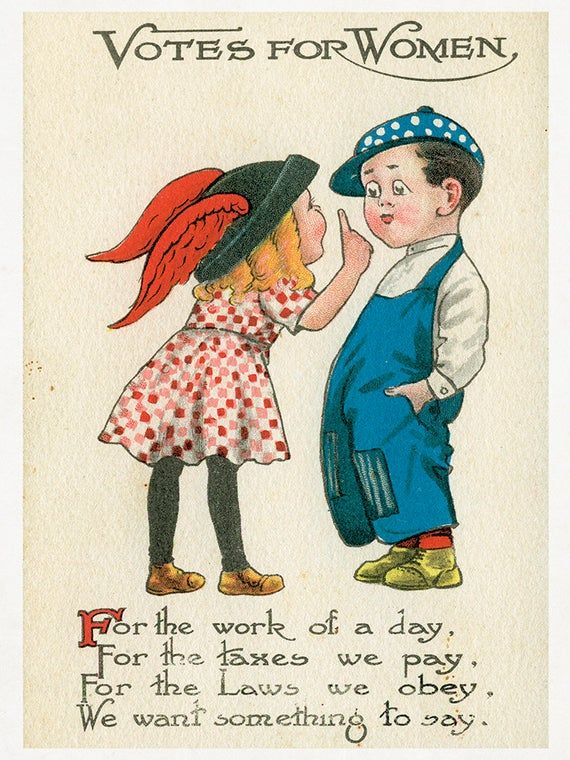
There were many women who spoke out on women’s rights. In the late 1700s, Abigail Adams, the wife of John Adams, wanted her husband to stand up for women’s rights but America wasn’t ready for equality at that time.
In the 1800s, Elizabeth Stanton proclaimed that women should have the right to vote and receive equal education. She had received a higher education at Troy Seminary in New York and felt all women deserved the right to be educated. When she gave lectures on the subject, it was frowned upon because it was solely a man’s place to speak publicly.
Susan B. Anthony was another who fought for equal rights. When she defied the laws and voted illegally on November 5, 1872 in a presidential election, she was arrested and fined $100. But she refused to pay it. She said, “Resistance to tyranny is obedience to God.” She was angry when she heard the politicians say that women wouldn’t understand politics, so there was no need to have them vote. It was up to the men to decide what was best.
Did you know that state law wouldn’t allow married women to own property? Since women didn’t have the right to vote, they saw no need for it. In a divorce settlement, the woman was not allowed to have any property.
In 1848, Elizabeth Stanton organized the first Women’s Rights Convention that was held at the Wesleyan Chapel in Seneca Falls, New York. They announced that they would have “a Convention to discuss the social, civic and religious condition and rights of woman.” Three hundred people showed up. Among the speakers were Elizabeth and African American abolitionist Frederick Douglass. Elizabeth was also an active abolitionist and believed that all men and women should be free to make choices in their lives and have equal rights.
A Declaration of Sentiments was written for the convention, which demanded equality for all United States citizens. In this manifesto, which was written primarily by Elizabeth Stanton, she used the Declaration of Independence as her inspiration: “We hold these truths to be self-evident; that all men and women are created equal.”
In 1878, the Women’s Suffrage Amendment was introduced to Congress but didn’t pass because they didn’t see any reason for the ladies to vote or be involved. It was resubmitted several times and was finally approved in 1919. But the bill had to be approved by two-thirds of the states next. On August 24, 1920, the bill was approved. But just barely! It was passed by only one vote. Harry Burn of Tennessee listened to his mother’s advice when she begged him to vote for Women’s Suffrage. On August 26, 1920, the 19th amendment to the United States Constitution was signed. It proclaims that the government cannot deny women the right to vote.
Did you know that some states gave women the right to vote before 1920? They didn’t wait for Congress to approve it. Wyoming gave women voting rights on the 10th of December 1869, Colorado was the 7th of November 1893, Utah was the 5th of November 1895–the year it became a state, and Idaho was in 1896.
Even though women had won the right to vote, that wasn’t all they had to fight for. Equal pay was another problem. Women, who had the same job as men, were paid less and sometimes their hours were restricted.
In 1942 during World War II, women had to work in factories to replace the men who had gone to war. Realizing the importance of women helping out during a time of need, the National War Labor Board said women who replaced male workers could receive equal pay. But it didn’t last long.
After the war, it was estimated that companies were paying women about two-thirds of what the men were paid. Women complained. It wasn’t fair. If they did the same responsibilities as the men, why couldn’t they be paid the same? Several women came forward and fought for equal pay, including Esther Peterson who represented the Women’s Bureau of the Department of Labor.
In 1963, the Equal Pay Act was presented to Congress and President John F. Kennedy signed the bill. It prohibited discrimination based on gender. Equal wages and equal benefits for equal work! The bill forbade companies from paying women less than men for the same skills. It also included some guidelines for higher pay such as seniority. Some businesses were not happy because they had to give their employees a raise in salary. There were still companies who tried to get away with paying women less and rebelled with the new law.
In 1970, the largest protest and strike in the United States took place, which was organized by the National Organization of Women. They demanded equal employment, salary, education, and childcare centers for those who had to work. There were demonstrations in 90 cities and 100,000 women participated. They hung 40-foot banners from the crown of the Statue of Liberty that read: March on August 26 for Equality. Another said: Women of the World Unite.
A group of women interrupted the American Stock Exchange by holding up signs that read: We won’t bear any more bull. Female teachers actually filed a lawsuit against the New York City Board of Education, demanding equal rights in administration positions. Even though there wasn’t immediate action taken, it took ten years to finally have female principals.
In 1971, Representative Bella Abzug introduced a bill to Congress that designated August 26th to be Women’s Equality Day. The bill was in commemoration of Women’s Suffrage and the 1970 Strike. Even though the bill wasn’t passed until 1973, the first Women’s Equality Day celebration was held on August 26, 1971.
Is this the first time you have heard of Women’s Equality Day? If you haven’t celebrated before, do it this year. Do something uplifting and charitable. What are you going to do on August 26th?